
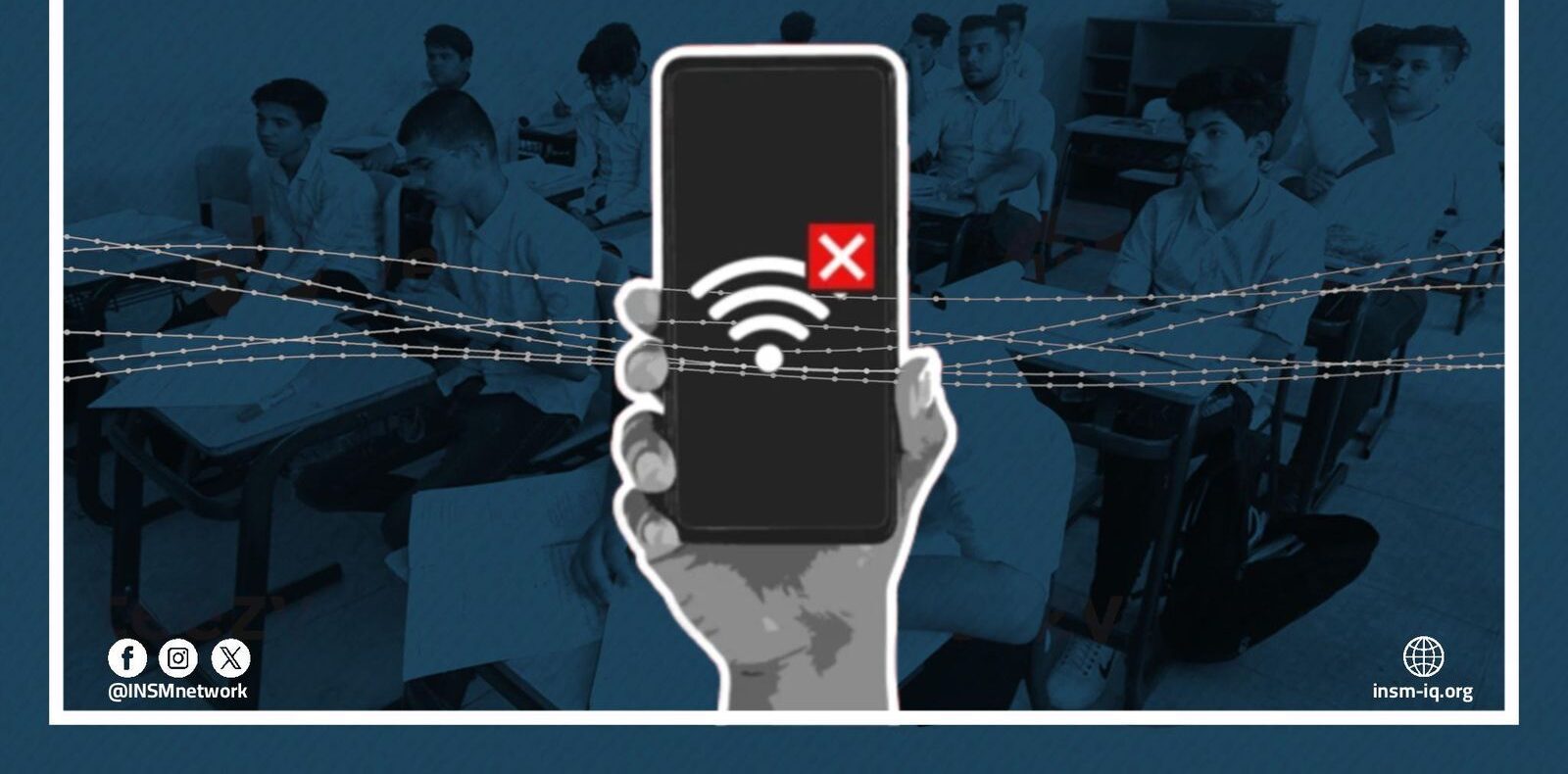

In recent years, Iraq has witnessed the repeated phenomenon of internet shutdowns during the periods of national exams (for third intermediate and sixth preparatory students). Authorities carry out this measure as a precautionary step, claiming it aims to prevent cheating and the leaking of exam questions online. Typically, internet service is suspended nationwide for several hours each day during the exam period—usually from dawn until the morning. This measure has become an almost annual practice since the mid-2010s, with the first recorded instance in 2015. It has since continued as a common practice, without serious attempts to explore alternatives.
These shutdowns have sparked widespread debate across Iraqi society. While official bodies argue that it is necessary to ensure the integrity of the exams, experts and human rights organizations view it as a violation of digital rights and harmful to the country’s economy and the interests of its citizens.
Declared and Undeclared Reasons for the Internet Shutdown
The official reason:
Government authorities, primarily the Ministry of Education, assert that cutting internet access is necessary to prevent cheating and the leaking of exam questions through social media. This decision came after repeated incidents in previous years where exam questions were leaked ahead of time. By shutting down the internet before and during the exams, authorities hope to stop the electronic circulation of questions and prevent students from using smartphones to cheat during the tests.
The Iraqi Ministry of Communications has stated multiple times that this measure was taken “based on high-level directives and at the request of the Ministry of Education” to ensure the integrity of the exams. For example, on May 20, 2025, the ministry announced the implementation of its decision to cut internet service daily from 6:00 AM to 8:00 AM throughout the first round of exams for the intermediate stage (from May 20 to June 4). The shutdown continued during the preparatory stage exams (from June 14 to July 3). Then, in August, the ministry announced a new wave of shutdowns during the second-round exams for both stages (from August 27 to September 13).
Despite the official justification related to preventing cheating, the internet shutdowns have sparked waves of anger and criticism. Many observers and experts believe there are other, undeclared reasons behind this policy. Iraqi tech experts and journalists have pointed out that resorting to internet shutdowns in this manner stems from internal issues within the exam system itself—namely, widespread administrative corruption within the Ministry of Education and its failure to secure the confidentiality of the exams. These failures include ineffective mechanisms for preparing, printing, transporting, and distributing exam questions. This internal dysfunction is repeatedly addressed through the “digital repression” of society as a whole.
The ministry would have done better to address the root causes of question leaks—such as securing the processes of question preparation, printing, and distribution—instead of disabling a vital service that affects millions of citizens. Voices within civil society argue that the government has adopted this extreme and superficial solution (cutting the internet) too easily due to a lack of accountability and weak public opposition. This has encouraged the authorities to implement the decision annually and normalize it as a tradition, without sufficient societal dialogue.
From another perspective, the repeated internet shutdowns during exams—and beyond—are seen as part of a broader desire by the authorities to control the digital space and restrict freedom of expression at every sensitive turning point. This policy has also appeared in other contexts, such as during the popular protests of October 2019, among others, which gives the impression that internet shutdowns have become a tool for security control and information suppression whenever higher authorities deem it necessary.
It’s also worth noting that the effectiveness of this measure is highly questionable. Leaks and instances of cheating have continued to occur despite internet shutdowns in some years. For example, in 2022, the third intermediate exam questions were leaked, and the Ministry of Education acknowledged the breach and postponed the exam—despite the internet shutdowns that had been implemented at the time. This reality suggests that internet blackouts have almost no success in preventing cheating.
In the same context, Asso Wahab, a digital security expert from INSM (Iraqi Network for Social Media), describes a similar situation in the Kurdistan Region, which, like other parts of Iraq, has experienced repeated internet shutdowns—often tied to official exam periods. However, both international and local reports indicate that these shutdowns have also occurred for other reasons, resulting in negative impacts on the economy, freedom of expression, and the right to protest.
Internet blackouts in the Kurdistan Region date back several years but have become more frequent and impactful in recent times. In addition to exam-related shutdowns, reports highlight other causes such as disputes between companies or attempts to suppress protests. For instance, internet outages began during the so-called “February 17” protests in 2011, which were among the longest and most significant. During the December 2020 protests in Sulaymaniyah province against the regional government, the authorities decided to cut off internet access for eight hours on December 7 across the entire region.
Internet Shutdowns Spark Internal Government Disputes
The decision to cut internet access has been a point of internal contention within successive Iraqi governments. Former Minister of Communications, Naeem Al-Rubaie (2018–2020), stated in a recent television interview monitored by INSM that he rejected the Ministry of Education’s proposal to cut the internet during his tenure. He emphasized that the economic losses caused by internet shutdowns across all sectors of the state reach billions of Iraqi dinars, stressing that it is the Ministry of Education’s responsibility to find a real alternative that ensures the integrity of the exams.
Similarly, the current Minister of Communications, Dr. Hayam Al-Yasiri, has also opposed the shutdowns, clearly stating that the Ministry of Communications is entirely against cutting internet access. However, the measure is implemented based on high-level directives from the Council of Ministers.
In contrast, Ministry of Education spokesperson Kareem Al-Sayyed defended the shutdowns in a televised interview, describing them as a temporary measure to protect students’ rights in light of the Ministry’s lack of adequate digital infrastructure. He noted that the Ministry cannot conduct exams without digital security and asserted that ongoing technological progress within the Ministry of Education will eventually lead to an end to these recurring shutdowns.
Economic, National, and Human Rights Costs of Internet Shutdowns
Despite the government’s stated commitment to automation, e-governance, digital economy enhancement, and electronic payments, the reality is that in recent years, decisions to block internet access during exams have caused substantial and growing economic damage to Iraq’s economy, while also harming the infrastructure of state systems. Some international and local organizations have attempted to estimate the extent of these losses:
-
Daily Direct Losses: Estimates by the Internet Society indicate that each day of internet shutdown results in approximately $1.4 million USD in losses to the Iraqi economy. In addition, there’s an estimated loss of around $120,000 USD per day in foreign direct investment due to shaken investor confidence. These are compounded by broader sectoral losses. For instance, considering the most recent exam period involved 22 days of internet shutdowns (according to Internet Society metrics), the estimated losses reach around $160 million USD. Although these outages last only a few hours each day, their cumulative impact affects productivity and trust in transactions throughout the entire day.
-
Annual and Aggregate Losses: In 2023, Iraq recorded the highest number of internet shutdowns worldwide, with 66 incidents—most of them during the exam season. According to Top10VPN, an organization specializing in monitoring the impact of internet blackouts, Iraq suffered the greatest financial losses globally, with around $1 billion USD in damages caused by exam-related internet shutdowns in recent years. Sudan and India followed on the list of most affected countries. Another previous study documented that between July 2015 and June 2016 (almost a full academic year), Iraq’s economy lost over $200 million USD in potential economic growth due to repeated internet blackouts—showing that this policy has been consistently applied for a decade, despite its damaging consequences and the absence of viable alternatives.
-
Percentage of GDP: Domestically, the Strategic Center for Human Rights in Iraq estimated that the total impact of internet shutdowns during exam periods accounts for around 0.5% of Iraq’s GDP—a significant percentage for an economy increasingly reliant on internet-based daily activities and growing e-commerce trends. The Center also stated in a public release that these daily shutdowns also lead to the suspension of 20% of communications across all local networks during blackout periods, effectively causing a partial paralysis in the communications and business sectors.
Beyond the Numbers: The Real-World Impact of Internet Shutdowns
In addition to raw figures, the economic impact of internet shutdowns in Iraq is deeply reflected in business confidence. International investors and companies now view the repeated disruptions to internet access as a serious risk factor, prompting hesitation in investing or expanding operations in the country. Organizations such as Access Now emphasize that even temporary shutdowns can have long-term economic consequences by destabilizing the country’s digital investment environment. Thus, the cost of internet shutdowns is not only measured by immediate revenue loss, but also by the missed future opportunities and the deterioration of Iraq’s digital infrastructure reputation on a global scale.
The effects of internet shutdowns extend far beyond direct financial losses to impact nearly every aspect of modern life. In Iraq, several key sectors have experienced tangible harm during these outages, including:
1. Freelance Work and E-Commerce Sector
Many businesses today rely on constant internet connectivity to manage operations—ranging from customer communication and order processing to logistics and financial services. When internet access is cut for several hours each day, these operations are disrupted, leading to operational losses and missed sales opportunities.
For instance:
-
Hassan (24), a designer, reported disruptions in fulfilling commitments with international clients due to the outage hours.
-
Salim (20), a driver for a ride-hailing app, said the shutdowns overlap with the start of official working hours, which hurts both drivers and passengers who rely on the apps for commuting.
-
He also noted that fuel stations using electronic payment systems are forced to halt operations during the outage.
Startups and online stores also suffer, directly affecting the incomes of business owners and their employees. Hussein (24), an e-commerce trader, told INSM he suffers significant financial losses during shutdown periods. Similarly, Zahraa (23), a young entrepreneur from Basra, said her online store’s sales are negatively impacted, especially since sponsored ads lose visibility and product reach declines due to the algorithmic disruptions caused by the shutdowns.
2. Financial and Banking Sector
At a time when Iraq is moving toward e-government and electronic payment systems, internet shutdowns present a major obstacle to completing financial transactions. These outages hurt both the government, by causing revenue loss, and the private sector, which depends on these services.
-
Money transfer companies and mobile payment services cannot function during blackouts.
-
Citizens and merchants are unable to complete electronic transactions or transfers, which stalls part of the daily economic activity and delays important business processes.
3. Education and Academia
Ironically, the internet is cut in the name of protecting the educational process (exam integrity), but the move significantly harms students and teachers alike.
-
Students increasingly rely on online resources to review and prepare for exams—especially with the rise of e-learning platforms and video lessons.
-
Many students reported to INSM that internet shutdowns in the mornings prevent them from reviewing materials or double-checking information before entering the exam.
-
Other students, including university students who may have exams during this period, also face connectivity loss—affecting their academic progress since many rely heavily on digital tools and platforms.
-
As a result, the entire educational environment suffers a digital blackout, impacting the learning process negatively during crucial periods.
4. Media and Journalism
The internet is the backbone of modern journalism and a core enabler of citizen journalism. During shutdowns:
-
Media institutions struggle to publish news and cover breaking developments, especially in fast-evolving events like recent regional conflicts.
-
This limits freedom of information, hampers the press’s watchdog role, and disrupts the public’s ability to stay informed in real time.
5. Activists and Civil Society
For human rights activists and civil society organizations, the internet is a vital tool for organizing and advocacy. Cutting access—even during exam periods, which are politically calm by nature—affects their ability to:
-
Monitor local and global events, and
-
Communicate with their communities.
Each internet shutdown—even if only for a few hours—restricts freedom of expression and peaceful online assembly, raising concerns that the government may grow accustomed to using exams as a pretext for silencing the digital space.
For ordinary citizens, these shutdowns can be life-threatening in emergencies. Imagine a medical emergency or fire during a shutdown—citizens would struggle to reach emergency services or request help promptly, especially in an age where apps play a vital role in rapid response.
6. Telecommunications and Technology Sector
Even internet service providers suffer reputational and contractual damage. Experts note:
-
The Ministry of Communications has contracts with international companies to provide internet services.
-
These shutdowns force the ministry to pay financial compensation for the service degradation, harming the government’s finances.
In terms of infrastructure:
-
A tech expert told INSM that restoring internet service after an outage is a gradual and complex process.
-
Devices that enhance internet speed, such as cache servers, can take up to 10 hours to return to full efficiency.
-
Users may experience slow connections or delays in content loading during the early hours post-shutdown due to pending background processes.
-
Samer (23), a programmer at a tech company, explained to INSM that even temporary outages can disrupt the functionality of software systems, leading to bugs or performance issues that persist throughout the day.
This means that cutting internet access for a few morning hours can degrade network quality for the rest of the day, leading to a subtle but real impact that users experience as lag, slow browsing, or reduced platform reliability.
Iraqis Living in the Unknown
The internet shutdown coincides with the escalation of conflict in the Middle East, as Iraqis wake up to the sights of missiles and aircraft flying over their skies, with growing domestic fears of Iraq being dragged into war, and a surge in rumors amid these extraordinary circumstances.
Researcher and political activist Al-Fadhel Ahmed told INSM that the internet blackout leaves Iraqis facing the unknown for hours, completely disconnected from regional and global developments and unable to follow updates on the worrying conflict unfolding around them.
A Costlier Cure Than the Illness?
In short, no segment tied to the digital economy or modern services has been spared the consequences of internet shutdowns during exams. This widespread harm has led many to question whether such a drastic measure (to prevent cheating) is proportionate to its broader societal and economic damage.
Some describe it as a “remedy more dangerous than the disease,” where the interests of millions of citizens and the country’s digital development have been sacrificed in a desperate attempt to control a problem that could be addressed by less harmful alternatives.
The Legal Dimension: Is Cutting the Internet Lawful?
The internet shutdowns in Iraq have raised serious legal questions regarding their compatibility with national laws and international obligations concerning freedom of expression and digital rights.
Under Iraqi Law & Constitution:
-
Article 38 of the Iraqi Constitution guarantees freedom of expression by all means.
-
Article 40 guarantees the freedom and privacy of postal, telephonic, and electronic communications, and prohibits surveillance or disruption except for legal or security necessity and with a judicial order.
Therefore, cutting off internet access nationwide, without a legitimate security emergency, casts doubt on the constitutionality of such action. It denies people their right to communication and information exchange without individual court orders or strict necessity.
Iraqi lawyers have strongly emphasized that such actions are “unlawful and contrary to the provisions of the constitution and current laws.”
In her statement to INSM, attorney Ilham Al-Rikabi from the Iraqi Lawyers Network confirmed that:
-
Internet shutdowns for exam purposes are illegal under both Iraqi constitutional law and international treaties ratified by Iraq.
-
These shutdowns violate the principle of legality, as there is no legal provision authorizing such action in exam-related circumstances.
-
Any restriction of constitutional rights must be based on clear, justified laws, and therefore such actions can be challenged in Iraqi courts.
A 2019 Precedent:
Lawyer Mohammad Jumaa filed a lawsuit against the Minister of Communications over the internet shutdown during the October 2019 protests, demanding the decision be revoked due to its unconstitutionality and the harm it caused.
Under International Law and Human Rights:
-
Article 19 of the Universal Declaration of Human Rights ensures everyone’s right to seek, receive, and share information and ideas via any media and regardless of frontiers.
-
Similarly, Article 19 of the International Covenant on Civil and Political Rights (ICCPR) guarantees the same rights and allows restrictions only under strict legal and necessary conditions.
A blanket internet shutdown, therefore, violates these rights by preventing millions from accessing essential information and restricting their freedom of expression and communication.
In a report issued in June 2022, the UN High Commissioner for Human Rights described the effects of internet shutdowns as “tragic,” emphasizing that such actions:
-
Undermine safety and rights, and
-
Obstruct transparency and accountability, especially when they accompany security crackdowns and restrict monitoring of human rights abuses.
The UN Human Rights Council, in Resolution 16/47 (2021), condemned the deliberate use of internet shutdowns to block or restrict access to information, calling such acts arbitrary and unjustified under any circumstance.
The UN’s position is clear: the internet is now essential for individuals to fully enjoy their rights, and any widespread shutdown must be extraordinary, proportionate, and subject to oversight.
Even during national emergencies, Article 4 of the ICCPR allows rights restrictions only to the narrowest extent necessary. Preventing exam cheating does not qualify as such an extreme necessity, meaning that internet access—being a basic right—should not be restricted for such purposes.
Media, Rights Groups, and Global Reactions
Outside Iraq, international experts have followed this phenomenon as part of a global trend of exam-time shutdowns. A report by Cloudflare, a network security firm, noted that:
-
Iraq pledged in 2023 not to cut internet access—but reversed course weeks later, enforcing shutdowns during exam periods.
-
This indicates internal disagreements among decision-makers about the legitimacy and utility of this practice.
International reports have compared Iraq to other nations, emphasizing that:
-
Most countries do not resort to this method,
-
Iraq, Syria, Algeria, and Sudan are exceptions, not the rule.
In a report by Human Rights Watch, it was noted:
“Even if the government’s intentions are good, this is a form of mass repression. It’s like using a hammer to smash something small—where the damage far outweighs the problem.”
Iraq’s Global Internet Freedom Ranking
According to the Freedom on the Net report—produced by INSM in collaboration with Freedom House:
-
Iraq recorded 66 internet shutdowns in 2023, most of them during national exams.
-
These shutdowns contributed to Iraq scoring 40/100 in internet freedom for the years 2024–2025, placing it in the “partially free” category and indicating serious concerns about digital rights and freedom of expression.
Positions of Human Rights and Digital Expression Organizations
The recurring internet shutdowns in Iraq have provoked strong reactions from numerous local and international human rights organizations concerned with freedom of expression and digital rights. These organizations have issued statements and appeals condemning the practice and demanding its permanent cessation. One of the most prominent responses came from:
The #KeepItOn Coalition – “No to Internet Shutdowns During Exams”
This coalition brings together civil society and digital rights organizations — including INSM — in a global effort to urge governments, including Iraq, to end the practice of internet shutdowns.
In May 2024, the #KeepItOn coalition sent an open letter to the Iraqi authorities, addressed directly to Prime Minister Mohammed Shia’ Al-Sudani, urging the government to refrain from blocking internet access during upcoming national exams.
The letter emphasized that Iraq is one of the few countries worldwide that continues to routinely implement this measure, warning that such practices violate international law and carry “unacceptable consequences” that infringe on human rights and should never be imposed, as affirmed by various UN statements.
