
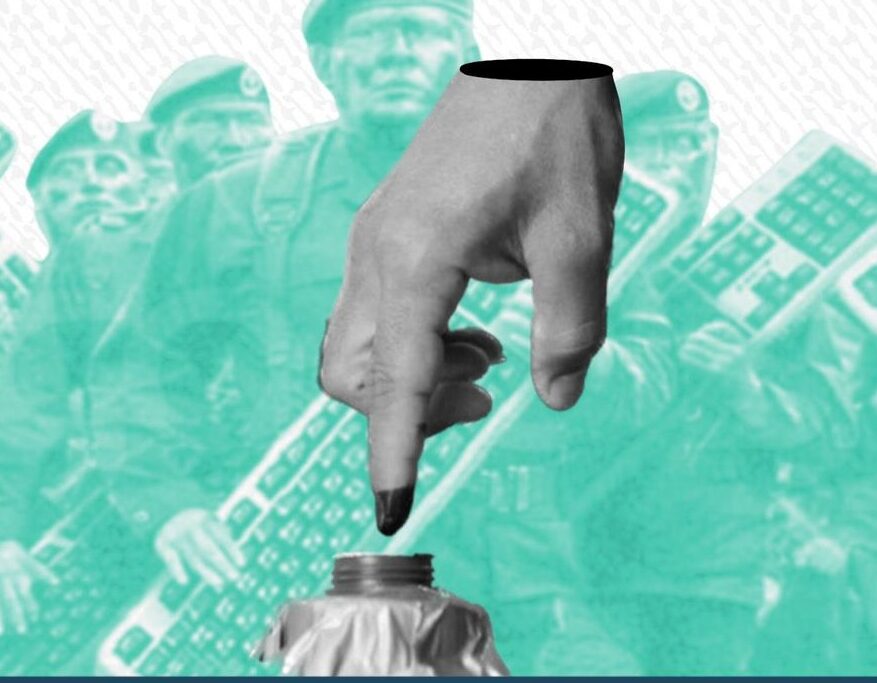

As the parliamentary elections scheduled for November 2025 approach, the political battle is no longer confined to ballot boxes or electoral platforms. It has forcefully moved into the digital space. What is now known as “electronic armies” has become a central tool in the hands of political parties and powerful actors — not only for self-promotion but also to discredit rivals and disrupt public discourse, in a context that places Iraq’s democracy under fundamental threat.
The Beginnings: Al-Maliki and the Creation of the First Core
According to Al-Araby Al-Jadeed reports, former Prime Minister Nouri al-Maliki was the first to introduce the idea of electronic armies in Iraq between 2010 and 2012. Leaked documents at the time revealed that he recruited dozens of journalists and activists to attack his opponents and defend him in return for fixed salaries that reached up to $600 per month. One participant (referred to as “H.A.”) stated that he was paid to conduct an organized campaign against an Iraqi judge who opposed al-Maliki, using mass reporting and flooding the judge’s page with insults until it was temporarily shut down.
This initial core meant that electronic armies in Iraq were linked to political power from the very beginning, rather than being spontaneous grassroots initiatives. When the starting point is the office of a Prime Minister and a political decision, the phenomenon takes on a form of “institutionalization,” even if unofficial. This early connection indicates that Iraq’s electronic armies did not emerge as a social reaction or youth initiative, as happened in other countries, but rather as a tool of authority used to eliminate rivals and reshape public opinion. In this sense, Iraq’s political system consciously sowed the seeds of digital chaos, gradually turning it into a permanent method of managing conflict — to the point where it’s now hard to imagine the electoral or media landscape without these armies. This also makes addressing the issue far more complex, since those expected to combat the problem are often the very ones benefiting from it.
Iraq Leads the Region
Al-Fallujah TV revealed that Iraq now leads Middle Eastern countries in the size and spread of electronic armies, surpassing even Iran and Gulf states. A single “electronic farm” costs around $25,000 and includes between 30,000 to 50,000 fake accounts. These are used for propaganda campaigns, buying followers, producing fabricated photos and videos, and eliminating political opponents.
This figure reflects the massive financial investment being poured into this industry, turning it into a massive electoral and economic tool. The $25,000 cost per digital farm shows that funding these digital armies is no longer just incidental campaign spending — it has become a part of the formal “election budget,” on par with television advertising or billboard costs. More dangerously, this funding isn’t limited to the election season. It is sustained year-round to maintain a constant digital presence and steer public opinion. In this way, electronic armies have become a profitable sector in themselves, employing hundreds of young people through unofficial contracts and linking them to political or even foreign entities, making them part of a political-economic market that escapes all oversight. In reality, these armies can be considered “digital contractors” working for whoever pays more — a dynamic that undermines national loyalty and turns political allegiance into a commodity bought and sold in digital auctions.
Experts’ Comments: “Mutual Smearing”
Iraqi affairs expert Hamza Mustafa explained that these armies “are no longer exclusive to one party; everyone uses them now,” noting that all are “paid for” and play a negative role by focusing on “smearing,” which leads to counter-smearing by the opposing side. Mustafa believes these campaigns distort public opinion and confuse Iraqi voters, who face a flood of moral and social accusations — pushing some to abstain from voting altogether.
This statement reveals that the phenomenon is no longer confined to a specific faction or party; it has become a general weapon used by all. While these armies were once associated with ruling parties or armed factions, today they are a shared tool for all competing forces, from major blocs to individual candidates. Each side runs its own version of a “digital army” and uses it in the same way — self-promotion and discrediting opponents. This widespread use has turned Iraq’s digital space into complete chaos, with each party attacking the other using the same methods, turning elections into battles of mutual defamation rather than competitions of ideas or platforms. More critically, this broad use of digital armies has erased the line between truth and propaganda. The public can no longer distinguish real news from content produced in political distortion labs. In this sense, the widespread nature of the phenomenon has turned the digital space into a tool for undermining trust rather than building it.
According to Al-Alam Al-Jadeed newspaper, political analyst Mohammed Naanaa explained that electronic armies became critically important to political parties and figures after the 2010 elections, when they were used systematically for the first time by supporters of Nouri al-Maliki. These were not ordinary activists — they were employees in government institutions, appointed specifically because of their digital activities, not their professional qualifications.
This description shows that the phenomenon did not emerge outside state institutions — it grew within them, making it part of the administrative and political structure rather than just a passing trend. Here lies an even greater danger: when “electronic armies” become extensions of official institutions, confronting them requires more than just deterrent laws — it demands a complete reassessment of how the state is managed. Public service becomes mixed with party propaganda, and the administrative apparatus turns into a hidden platform for political battles.
“Digital Flies,” Not Cyber Armies
In a 2021 article in Al-Sabah newspaper, expert Safad Al-Shammari distinguished between organized cyber armies possessed by major countries like China, the United States, Russia, and Israel — which are formal units for cyber offense and defense — and what exists in Iraq. He argued that the local phenomenon doesn’t rise to the level of an organized “electronic army,” but is closer to “digital flies,” consisting of small squads operating hundreds of fake accounts used for political whitewashing or smear campaigns.
The motivations for joining these squads are often financial or ideological. This reflects the realities of youth unemployment and lack of job opportunities — pushing many to engage in this activity as an alternative source of income. This distinction is important to understand that Iraq still lacks a formal cyber army in the global sense, but rather has fragmented networks operating on political mercenarism. While the article is from 2021, current indicators suggest that not much has changed. The scene is still one of digital chaos and partisan exploitation, rather than the construction of a national cyber security infrastructure.
Conclusion
Electronic armies in Iraq are no longer a marginal phenomenon — they have become part of the country’s political and security structure. They are an electoral tool, an instrument of repression, and a mechanism for influence. While other countries treat electronic armies as national cyber units for defense, Iraq remains immersed in “digital flies” operating for hire and political funding, in ways that violate many democratic principles — such as threatening, insulting, or defaming opponents. This chaotic mercenary activity is a serious threat today, especially with the 2025 elections approaching.
The key question remains:
Can a national, independent cyber system be built to protect society from manipulation, blackmail, and digital violence? Or does digital chaos continue to serve those in power — who have no interest in regulating this space?
