
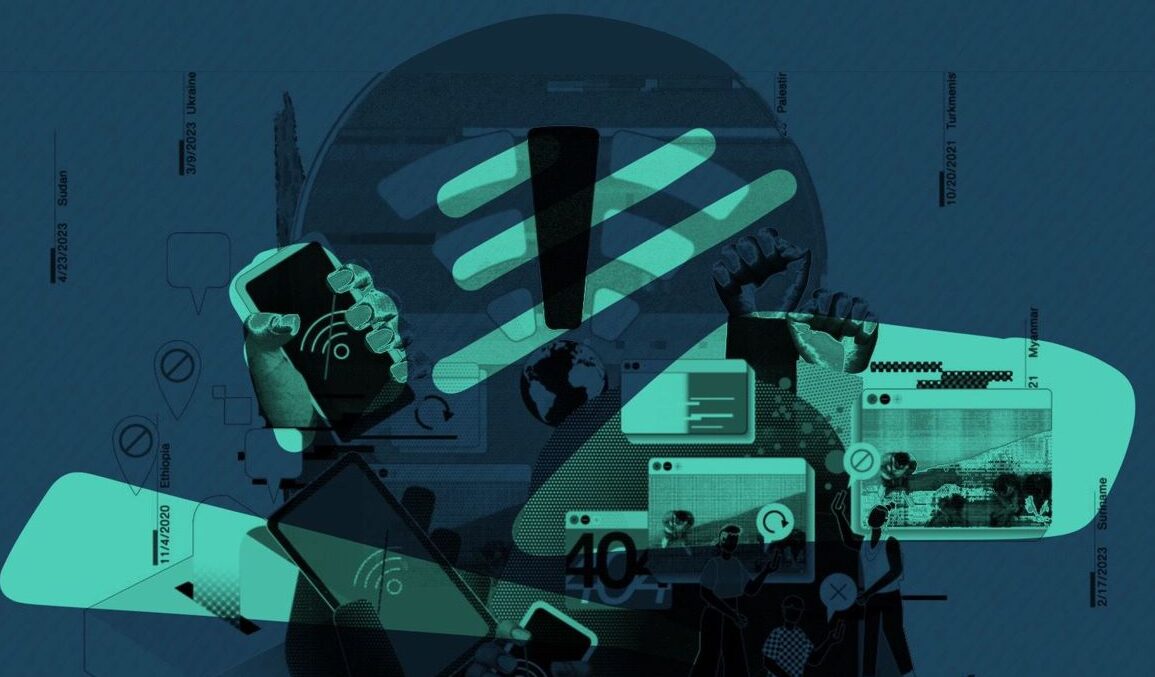

With the increasing reliance on social media platforms like Facebook, X (formerly Twitter), Instagram, and YouTube, algorithmic systems have become the invisible force shaping political discourse. What is known as “soft censorship” does not usually appear as outright deletion, but rather as the downranking or limited visibility of political or analytical content through recommendation and ranking algorithms — all without clear human intervention. This significantly reduces the content’s ability to reach its intended audience effectively.
Filter Bubbles and Echo Chambers
Algorithms perpetuate what is known as “filter bubbles” and “echo chambers,” showing users content that aligns only with their previous preferences. This reduces exposure to opposing views and deepens ideological polarization. A recent study published in Applied Network Science supports this understanding, using intensive social modeling to confirm that algorithmic mechanisms contribute to the disruption of public political debate.
Emotion Over Substance
It’s not just about what content is shown, but what content is promoted. Studies in PNAS have found that posts evoking emotions like anger or sadness spread more rapidly than calm, analytical content. This dynamic marginalizes reasoned discussion and factual information, and contributes to the emotionalization of political discourse.
Another study found that such emotionally charged content thrives within political messaging, explaining the rise of emotion-driven narratives over nuanced argument.
Political Bias in Algorithmic Promotion
A comprehensive analysis of X showed that recommendation algorithms amplify right-wing political content more than left-wing content across most countries studied. This was based on a controlled experiment involving 2 million user accounts, revealing algorithmic bias in political recommendation patterns.
Algorithmic Bias Against Local Dialects
There’s growing interest in the field of algorithmic bias, especially regarding the automatic suppression or misclassification of content written in local Arabic dialects, such as Iraqi or Levantine Arabic. Because algorithms often lack cultural context, this content can be downranked or excluded, even when it’s factually accurate or valuable.
In many cases, political content is not banned explicitly, but is quietly removed from algorithmic recommendation systems. The posts remain visible in theory, but are not promoted, not suggested, and don’t appear in users’ feeds — a form of “algorithmic invisibility.”
A study on digital censorship of Palestinian activists found that many posts were removed from recommendation systems without explanation or notice, resulting in “algorithmic silence,” even though the posts technically remained published.
Arab and Iraqi Context: Shadow-Banning Without Violation
In the Arab and Iraqi context, reports from human rights organizations show that content related to Palestinian issues or civil activism often faces digital marginalization or shadow-banning, even when it doesn’t violate platform policies.
For example, Access Now and its partners documented over 1,049 instances of content removal or restriction for posts supporting the Palestinian cause — without clear justification. This points to algorithmic filtering targeting political content without any visible human moderation.
A research paper titled “Who Should Set the Standards?” revealed that Arabic-speaking users perceived a vast disconnect between Facebook’s Community Standards and how they were applied. In one case, 448 Arabic-language posts were deleted or restricted during a Palestinian conflict without clear reason, according to assessments by ten neutral evaluators — highlighting a lack of transparency and accountability in algorithmic content management.
The Right to Understand Algorithms
Users currently have no real right to understand how algorithms work or why some posts are promoted while others are ignored. Legal scholars have proposed the concept of a “Digital Right to Know,” advocating that users should have the right to know how and why content is recommended or suppressed — a basic right that demands clear legal backing.
The Conflict Between Commercial Interests and Public Discourse
Ultimately, the tension between platform profits (measured by engagement time and advertising revenue) and the public interest (freedom of thought and democratic discourse) plays out within what is often referred to as “the algorithmic black box.”
Media reports have shown that administrative changes within major tech platforms — especially after acquisitions or internal restructuring — have led to the silencing of human rights or analytical content in response to commercial or political pressures.
Conclusion: Algorithms as Political Actors
The findings in this report suggest that soft censorship via algorithms is not a neutral technical outcome — but a fundamental shift in how information and knowledge are controlled in the digital space.
The ability of platforms to steer attention, limit visibility, and do so without direct censorship or explicit intervention places them in a position of informational authority. They no longer merely mediate content — they determine what is seen and what is forgotten.
In this environment, serious political discussion and critical analysis become less accessible — not due to their quality, but due to a structural clash between the logic of platform algorithms and the logic of public knowledge.
Treating algorithms as purely technical tools ignores their political impact in reshaping the public sphere. This calls for systematic accountability, and the development of legal and ethical frameworks to ensure that the so-called “neutrality” of algorithms does not become a cover for covert, organized exclusion of independent and analytical voices.
