
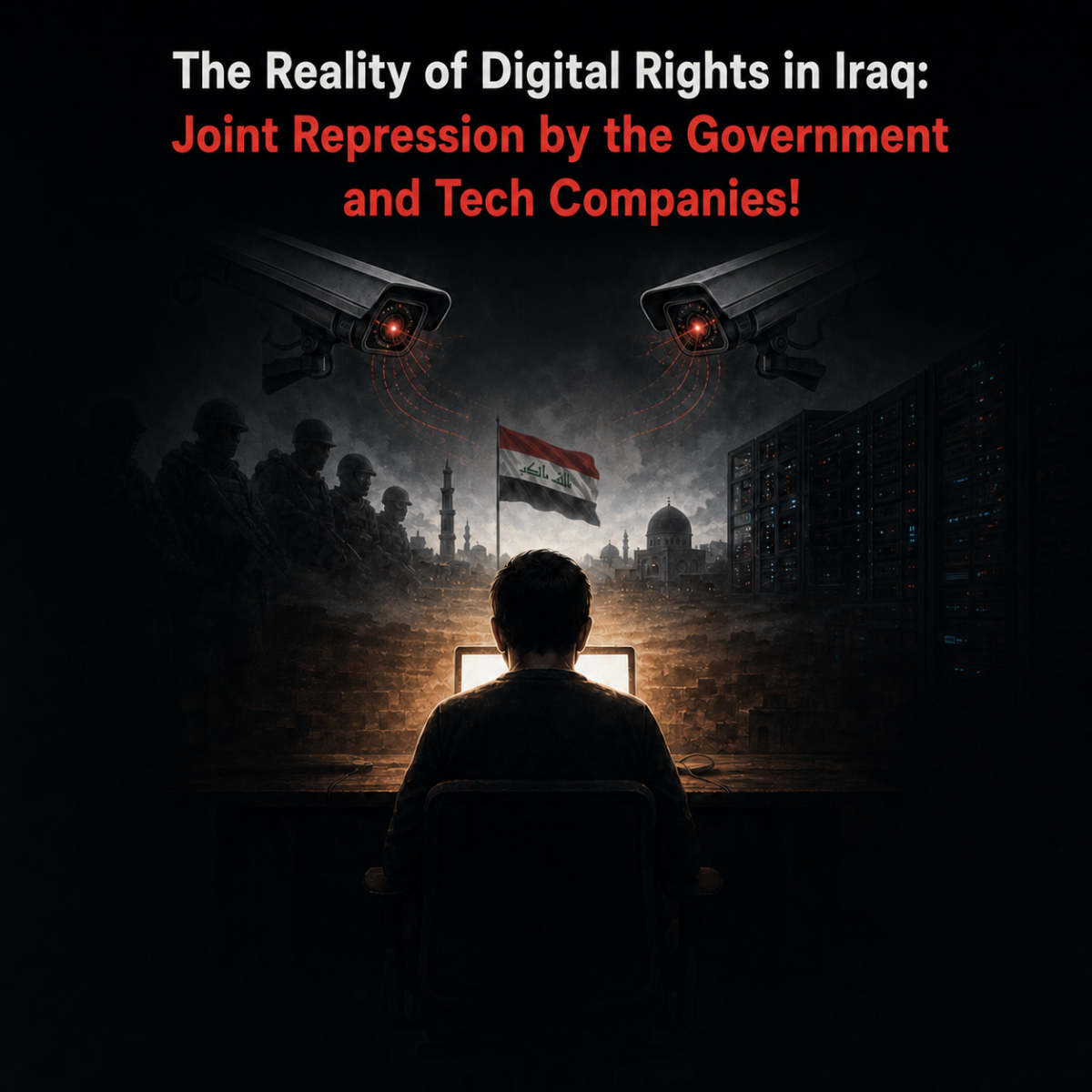

The Reality of Digital Rights in Iraq: Joint Repression by the Government and Tech Companies!
This article was written by Haider al-Mousawi of the “INSM” organization for the Digital Rights Coalition in the Middle East and North Africa. To read the original article, click here
As successive Iraqi governments have taken office since the fall of the Ba’ath Party’s dictatorial regime in 2003, digital rights organizations and human rights defenders have continued their efforts to build a digital space that guarantees digital freedoms and establishes them as an inalienable fundamental human right. At the same time, Iraqi governments continue to shut the door on this activity, and their policies have led to the creation of new tools that suppress digital freedoms, rather than guaranteeing and fostering them.
Perhaps the most notable step taken by the Iraqi Parliament to obstruct these efforts was its disregard for the “Law on Access to Information”, which, had it been implemented, journalists, human rights defenders, and even the general public to access the information they need to help promote transparency and curb corruption by investigating and exposing it. The draft legislation remains stuck in parliamentary drawers, with only timid attempts to discuss it; at the same time, attempts emerged to enact laws and regulations to “regulate media content” or “combat cybercrimes,” which were riddled with loopholes designed to restrict freedom of expression rather than build a free digital space.
As an extension of the Iraqi government’s policies—which do not prioritize digital freedoms—and given its inability to pass the laws and regulations it had intended to enact due to pressure from civil society organizations and digital activists, we observed the government resorting to certain “alternative” tools, in order to restrict the digital space and its users without the need to pass any legislation.
The “Balagh” Platform: “Combating Vulgar Content”
On January 10, 2023, the Iraqi Ministry of the Interior launched a digital platform called “Balagh,” as a tool to combat what it described as “offensive content” that “offends public decency, violates modesty, and undermines social stability.” This marked the beginning of restrictions on the freedoms of content creators, the imposition of digital oversight on influencers, and the establishment of what is permitted and what is prohibited.
The Ministry of the Interior did not explain any constitutional or legal mechanisms regarding the metrics and criteria used to classify content. The arrests and detentions resulting from reports filed through the platform included singers, comedians, and female activists in the digital sphere, as well as poets and owners of restaurants. The platform also caused psychological harm to those labeled as producing “vulgar content.”
The negative impact of the “Report” platform was not limited to digital restrictions, the imprisonment of women, and forcing them to practice a form of self-censorship; it went so far as to pose an actual threat to their lives. On April 26, 2024, Iraqi influencer Umm Fahd was assassinated in front of her home in the capital, Baghdad, by an unknown assailant, after the “Balag” platform had constructed a negative stereotype of her; The influencer was imprisoned under the platform’s procedures, which stigmatized and incited against her until she was assassinated, while her assassin escaped punishment.
The platform is still in use today.
The Media Commission and the National Contact Point: A New Tool for Restriction
A digital entity known as the “National Contact Point” has recently emerged. It appeared to a number of bloggers and journalists on Facebook after their posts and accounts were blocked in Iraq, and others were permanently removed, due to a “legal request” submitted by the “National Contact Point” to Meta, or to protect “copyrights,” without providing a clear reason for the violation on which the blocking was based. The blocked posts included content related to exposing corruption cases and another concerning the new Iraqi Prime Minister Ali Faleh al-Zaydi; they did not contain any violations of Meta’s standards or infringe upon “rights,” as stated in some of the blocking notices.
According to the notifications of blocking actions faced by a number of bloggers and activists on “Facebook,” the blocking decision does not allow the page owner to appeal the decision, discuss it, or understand how it conflicts with local laws, as the notification reads: “Your post is unavailable in Iraq. Reason: Based on legal request No. (####), we were compelled to restrict access to your post.”
In November 2025, Meta stated that it had received 51 requests from the “Iraqi National Contact Point” to restrict access to 52 Facebook pages and groups and 327 posts on Facebook and Instagram. It explained that failure to comply with requests from the National Contact Point could result in a potential ban on advertising and the Central Bank blocking payments to Meta.
According to Meta’s statement, as of the date mentioned above, it had restricted access to 194 posts on Facebook and Instagram that allegedly contained defamatory statements and insults against the prime minister, the ministers of defense and interior, the head of the “National Wisdom Movement” Ammar al-Hakim, members of the Iraqi security forces, members of parliament, the Media and Communications Commission, the Iraqi judiciary, the mayor of Baghdad, and the Basra police chief.
Among the content blocked by Meta was digitally manipulated material or content generated by artificial intelligence, as well as leaked government documents, on the grounds that they “violate local law.” In contrast, Meta took no action regarding 49 Facebook pages and a group that reportedly contained criticism of government officials and political candidates, as well as allegations of corruption targeting members of parliament, the Ministry of Electricity, and the Wasit Electricity Distribution Branch, in addition to government documents allegedly leaked.
Meta’s approach to blocking content indicates a troubling shift in the nature of its response to requests it receives, as it complies with requests based on repressive and vague laws—such as those in Iraq—and government perspectives that are not grounded in standards or criteria for classifying content. Furthermore, the company’s response was not grounded in the protection of freedom of expression or the public interest in the digital sphere, but rather yielded to pressures that threatened its economic and promotional interests in Iraq.
The head of the “Media and Communications Commission,” Baligh Abu Kallal, appeared in a new television interview, in which he revealed details regarding the “National Point of Contact,” explaining that it is an Iraqi body that he personally heads and that includes members from the Iraqi Intelligence Service, the National Security Agency, the Judicial Council, and the Ministry of Communications. He noted that blocking decisions are made unanimously by these entities after review, and reasons are provided, such as support for terrorism, incitement to sectarianism, and content “contrary to public morals.”
In its policies regarding content restrictions, Meta states that it blocks access to content in accordance with local laws, explaining that “when governments believe that online content violates their laws, they can contact Meta and request that access to that content be restricted.”
Furthermore, the company clarifies that “if, after a thorough legal review, we determine that content is illegal under local law, we will make that content unavailable in the relevant country or region.” For example, Holocaust denial is illegal in Germany; therefore, if we are notified of content related to this, we will restrict the visibility of that content to people in Germany.” Here, it can be said that Meta’s standards no longer rely on its own general criteria but rather respond to any legislation in a specific country, even if it falls outside the context of a violation of its standards.
During the interview, Abu Kallal mentioned an incident involving a political analyst who accused former Prime Minister Muhammad Shia’a al-Sudani of “collaboration and normalization” in a tweet posted on his X account, after which the analyst was barred from appearing in the media. Abu Kall added that “he does not condone insults directed at the Iraqi prime minister, nor can he accept accusations of collaboration against his prime minister without taking action.”
This statement raises questions about the criteria for determining what constitutes an offense warranting punishment and censorship, as well as the line between freedom of expression and violations of digital standards, from the perspective and interpretation of the “Media and Communications Commission.”
It is worth noting here that Abu Kalal is a prominent leader in one of the political parties, and while he serves as chairman of the “Media and Communications Commission,” cases of blocking were observed involving critical content that exposed corruption cases linked to the political entity to which he belongs, raising serious concerns about the potential exploitation of the authority’s resources to serve political interests.
The Iraqi judiciary supports the blocking of content and websites; on March 14, 2024, the Federal Supreme Court issued a ruling ordering the blocking of websites, internet networks, and electronic communication applications that involve “the production and dissemination of material that violates morality and decency, as well as vulgar content that offends modesty, insults the divine essence and the sanctity of holy books, insults prophets, messengers, and religious symbols, defames religions and sects, and promotes and disseminates debauchery, immorality, prostitution, and homosexuality, and harasses and insults others.” These are a set of charges, each of which is open to multiple interpretations and meanings and can be applied to virtually any content.
Blocking the “Telegram” App
As the use of the “Telegram” app in Iraq has increased for various purposes—most notably education—the app has been blocked several times, most recently on April 3, when the app suddenly stopped working across all Iraqi provinces except the Kurdistan Region, without any official announcement from the government or the company that owns the app. This prompted users to seek alternative solutions to access Telegram, such as using virtual private networks (VPNs), especially since the block affected users’ ability to work, communicate, and study, and exposed them to risks associated with using unsafe methods to bypass the block.
About a month after the app was blocked, the Media and Communications Commission announced that the block had been lifted, after the app’s management pledged to comply with regulatory requirements regarding content moderation and user protection, and to adhere to the legal frameworks in force in Iraq, according to the Commission, which affirmed its readiness to reimpose the block in the event of non-compliance.
The Dilemma of Internet Shutdowns
The development of digital tools for document protection and the fully controlled management of digital operations has not put an end to decisions to shut down the internet during exam periods. The new Minister of Communications, Mustafa Sanad, announced an internet shutdown lasting one and a half hours, from 6:00 a.m. to 7:30 a.m., during the exam period, under the pretext of curbing the leakage of exam questions prior to exam dates—a phenomenon that has recurred in recent years—without implementing any radical solutions other than the internet shutdown, which disrupts the work of millions in Iraq.
Sanad explained that over the coming year, he will strive to achieve the goal of completely eliminating internet shutdowns during exams through special mechanisms that allow the Minister of Education to “press a button” to deliver exam questions to all schools simultaneously, thereby preventing their premature leakage. This remains a plan on paper, with all eyes on what 2027 will bring.
Digital Activity Justifying the Killing of Women
The “Media and Communications Commission” and the Ministry of the Interior claimed, via the “Balagh” platform, that they are combating “vulgar content” that incites hatred and undermines security, but the reality on the ground is far from that. Hate speech, incitement, and threats—especially those directed against women—are spreading across social media platforms without any significant government action, even though there are well-known platforms affiliated with outlawed armed factions that continue to publish their inflammatory content with impunity.
On March 2, 2026, human rights defender and feminist activist Yinar Muhammad was killed in an armed attack outside her residence in northern Baghdad. Concurrent with the incident, posts reporting her death circulated, accompanied by comments justifying her killing and inciting the killing of others, No security measures were taken regarding these posts or against those who shared information about or incited her killing. Furthermore, as of the time of this report’s writing, security authorities have not revealed the identity of the killer, who has evaded punishment thanks to the digital environment that justified his actions.
This takes us back to 2020, when civil society activist Reham Yaqoub was killed after a digital campaign was launched against her accusing her of being a collaborator; the killers were neither held accountable nor identified.
Exploitation of the Digital Sphere to Restrict Digital and Public Freedoms
Digital repression is on the rise in Iraq due to the aforementioned government tools, and cases of imposing “digital guardianship” on content creators and inciting the suppression of women’s freedoms via social media have begun to spread.
For example, content creators are waging a constant attack against other content creators who are younger and less influential than they are, because they did not like the content, or because they do not want to allow women to share their views, among other reasons. They are supported in this by thousands of users, who participate in online incitement under the pretext of combating “vulgar content”—a campaign that often ends with the victims falling into the hands of the Ministry of the Interior as a result of the creation of hostile online public opinion against them.
As an example, an Iraqi journalist, via his Facebook page—which has over two million followers— the Ministry of the Interior to intervene and ban women from smoking hookah in public places, exploiting the support of thousands of social media users to justify repressive measures under the guise of “sanctity” in order to restrict a basic right. The same journalist also imposed his authority on a restaurant owner and an advertising campaign, forcing him to issue a public apology for the actions of content creators who had promoted his products and contests.
In addition to all this, lawsuits filed by government officials—most notably ministers in the former Iraqi prime minister’s government, and even the president himself—against bloggers, activists, and journalists over posts on social media have led to their imprisonment.
Furthermore, leaks of users’ public data continue, without any government transparency regarding these incidents or recommendations for addressing this serious challenge. Government actions have also demonstrated negligence in this regard, as the Iraqi government announced on June 29, 2025, that it was donating 12,000 “tablets” it had used to conduct the 2025 census to the Kingdom of Jordan, without providing any transparent information about how it handled Iraqis’ data prior to taking this step, or what precautions it took to preserve their privacy—despite its assertion that the devices were free of data.
As the frequency of these practices and incidents escalates, concerns are growing and diversifying regarding the worsening of restrictions on freedom of expression online, the undermining of journalists’ freedom and their access to information, and the spillover of digital violence into the real world—particularly against women. All of this is taking place while the Iraqi Parliament remains determined not to fulfill its role in safeguarding the freedoms its members swore an oath to protect, and instead tends to become a party to the increasingly widespread digital repression.
