
Original Article on SecDev Foundation site
What began seven years ago as an effort to understand digital violence against women has evolved into a region-spanning community of researchers, practitioners, and organizations driving lasting change.
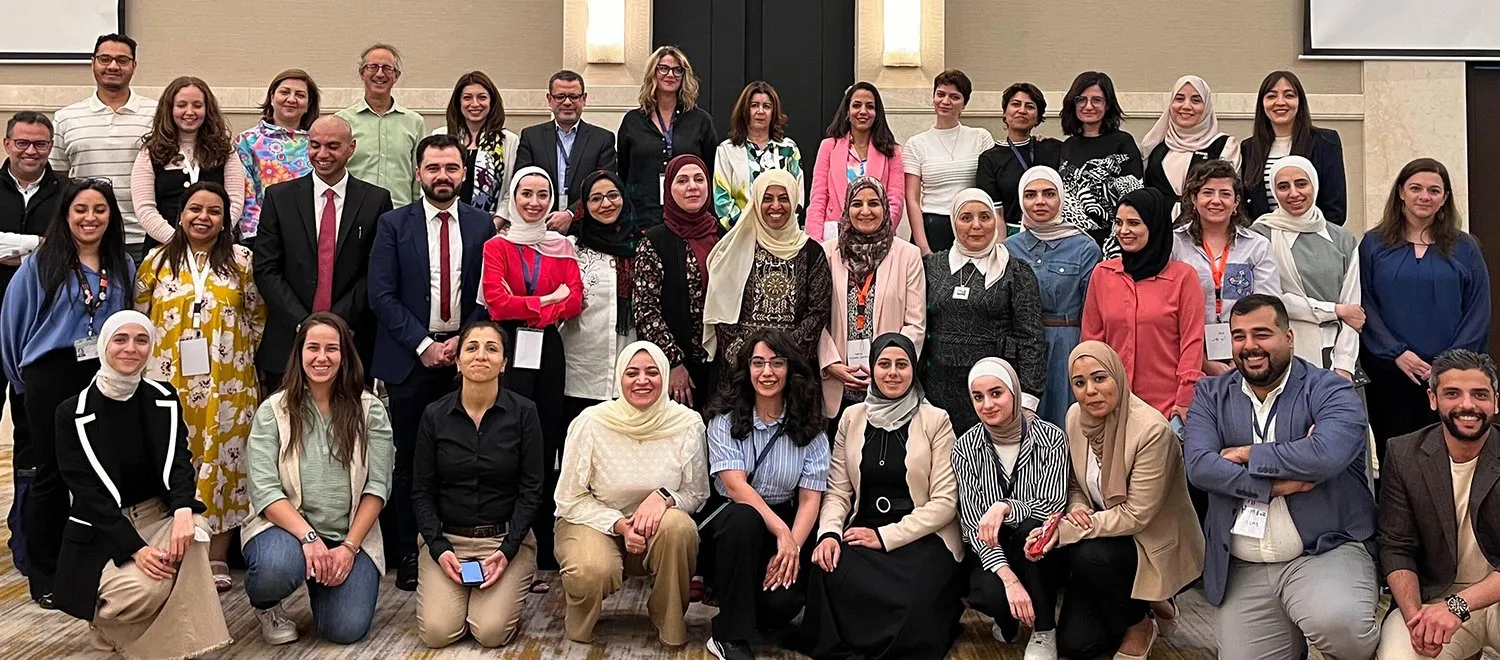
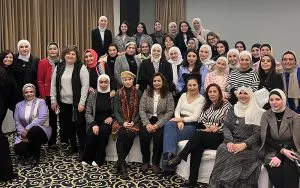
In April 2024, nearly 100 women from across the Middle East and North Africa (MENA) gathered at the Mövenpick Hotel in Amman, Jordan. With an ambitious agenda spread across two days, this was MENA’s largest-ever regional summit on digital violence against women (DVAW).
Researchers sat alongside journalists. Lawyers exchanged ideas with educators. Psychologists, activists, policymakers, and community leaders compared experiences gathered from countries separated by geography, politics, conflict, and language.
Just a few years earlier, most of the people in that room had never met.
Many had never heard the term DVAW. Others were wrestling with the issue without realizing how many others across the region were doing the same. Yet despite their different backgrounds, they shared a common experience: each had encountered women whose lives, careers, activism, education, or wellbeing had been altered by harms originating in digital spaces.
What emerged in that room was more than a project or publication. Researchers and practitioners alike were recognizing how the dynamics they had been facing in their own countries formed part of a much larger regional story. The summit did not create that realization. Instead, it made visible what had been quietly taking shape for years: a community capable of understanding, documenting, and responding to digital violence against women together.
When the harm had no name
Women across the MENA region had been grappling with DVAW for years. Journalists abandoned stories after coordinated online attacks. Activists faced harassment and intimidation. Women candidates and public figures endured smear campaigns designed to silence them. Young women navigated blackmail, cyberbullying, impersonation, and image-based abuse, often with little understanding of where to seek help.

The harms appeared in different forms and different contexts. They were discussed using different language. Various institutions addressed their effects in different ways. Women often navigated these experiences alone. Many did not know where to seek help, whether existing laws applied, or whether what they were experiencing had even happened to others.
What connected these harms was not immediately obvious. DVAW sat at the intersection of gender inequality, technology, freedom of expression, and violence against women. Yet few institutions were examining it as a distinct phenomenon. Researchers lacked evidence. Service providers lacked tools. Policymakers lacked data. Practitioners lacked common terminology and referral pathways.
Everyone could see the symptoms. Few could see the system producing them. What was missing was not concern or commitment. It was a framework through which these experiences could be understood, documented, and addressed collectively.
Roots in frontline practice
SecDev hired me seven years ago to work with communities on practical digital safety awareness, training, and support. Today, I collaborate with local, regional and international partners as a recognized voice on DVAW. In many ways, my personal path reflects SecDev’s wider journey.Lina Momani, Salam@ partnerships lead

One of the places where that gap became impossible to ignore was in the frontline digital safety work of The SecDev Foundation’s Salam@ program. SecDev already had years of experience in the region through its SalamaTech Syria first responders. And this new foray would both widen the geographic scope and tighten the focus — to building digital resilience among women and girls.
Between 2018 and 2022, Salam@ worked across seven MENA countries: Algeria, Bahrain, Jordan, Kuwait, Libya, Morocco, and Tunisia. Through digital clinics, training programs, and direct support, the team helped tens of thousands of women and girls navigate an increasingly complex digital environment. Through deeply localized public awareness campaigns in each country, they helped millions more learn to protect themselves from growing threats of online harm.
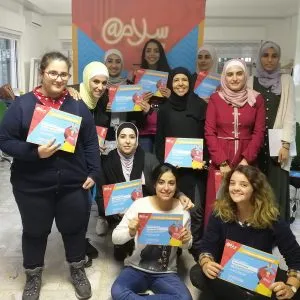
Salam@ became a trusted source of digital safety information across the region. Women sought support for hacked accounts, privacy violations, blackmail threats, and harassment. Youth participated in digital resilience initiatives and awareness campaigns. Journalists and activists came looking for practical advice on protecting themselves online.
In each of the seven countries, Salam@’s young national coordinators were emerging as public voices on digital rights. People like Lina Momani (Jordan), Laila Mnekebi (Tunisia), Mounir Naili (Morocco), and Fatima Zohra Feriel Menouar (Algeria) became sought-after speakers. By 2022, team members had logged more than 450 appearances in print and broadcast media. This helped bring issues such as online harassment, blackmail, and privacy into mainstream discourse.
Women substantially drove this work, but they did not carry it alone. From these early years onward, male colleagues and allies also contributed as trainers, researchers, practitioners, and advocates — helping open more doors and extend the effort into new spaces.
Building blocks
Two developments in this period would ultimately shape everything that followed.

First, Salam@ was building invaluable human infrastructure: new digital safety trainers and partners across MENA. Together, they helped pioneer a new generation of Arabic-language digital safety resources designed for everyday women and the organizations supporting them—not just technical specialists. These included localized training and outreach materials, along with foundational resources such as the region’s first psychosocial support manual for frontline DVAW responders and its first Arabic-language digital safety dictionary in sign language. Just as important was the network of relationships—with local partners who co-led strategy in each country, and with practitioners, journalists, researchers, and others who helped shape every product and activity.

Second, as the team continued confronting real cases with real women, they realized they were not simply responding to online threats. In all seven countries, women spoke about fear, self-censorship, damaged reputations, social stigma, and withdrawing from public life. And consistently, what happened online did not stay online. Digital violence was constraining women’s opportunities, relationships, activism, education, and civic engagement in the offline world as well.
Yet many of the most important dimensions of the problem remained poorly understood: its prevalence, its consequences, and the forms of support available to women experiencing it.
The more practitioners listened, the clearer it became that stronger passwords and better privacy settings were surface-scratching solutions. The field lacked the language and evidence needed to understand DVAW as a social, psychological, legal, and institutional challenge — and to identify the systems required to respond.
Building the map together
The first studies emerged from much more than academic curiosity. They emerged because women were asking questions that nobody could answer. Dr. Nadia Al-Sakkaf, Salam@ lead researcher

So began the DVAW research project that nobody had envisioned three years earlier. Salam@ had already assembled some key ingredients: unanswered questions from the field, trusted local partners, and a growing network of researchers ready to explore them. In 2021, a modest pool of funding for research helped bring those pieces together.
Early on, Dr. Amel Grami explored how digital violence was silencing female political activists in Tunisia. Dr. Houda Haj Qassem explored the complex digital tactics used to suppress female journalists there. Two humanitarian experts, Sanaa Hamadouche and Feriel Kessai, teamed up to study the psychosocial impacts of DVAW in Algeria.
Research expanded to Jordan, Yemen, Libya, Kuwait, and Bahrain — led by women rooted in those places. In every case, the authors put forward thoughtful recommendations for next steps. New questions generated new studies. New studies revealed new gaps.

The work was soon resonating far beyond Salam@’s seven-country footprint. That’s when Canada’s International Development Research Centre (IDRC) saw the potential to deepen the evidence base in the region to complement their work supporting tech-facilitated, digital violence research globally. With IDRC’s support, new researchers, organizations, and country teams joined the effort, extending the work across North Africa, the Levant, the Gulf, and conflict-affected settings. The new partnership reflected IDRC’s distinctive approach of strengthening locally-rooted expertise, while helping knowledge from one context inform action in others.
Women researchers embedded within their own communities led the work in each country, ensuring that the research remained grounded in local realities while benefiting from mentoring, peer learning, and technical collaboration across the growing network. Ultimately, the effort grew to encompass 18 countries, with each new study illuminating another piece of a much larger puzzle.
Patterns across borders
At first, researchers worked largely within their own national contexts. Yet as findings began to circulate, something unexpected happened. While differences between countries remained important, similarities became impossible to ignore. Women across the region were describing common patterns of harassment, intimidation, exclusion, blackmail, surveillance, and reputational attacks. The technologies varied. The legal frameworks differed. The social contexts were distinct. But the underlying dynamics were strikingly familiar.
As the work expanded, gradually, something shifted. Researchers stopped seeing themselves as only national authors — and began recognizing that they were documenting different dimensions of a wider regional phenomenon.
In Somalia and Mauritania, researchers found that clan and tribal structures could act both as sources of protection and mechanisms of control. In Lebanon and Tunisia, women journalists, activists, and public figures described intense scrutiny of their appearance and behaviour. The manifestations varied, but the underlying dynamics often pointed to the same deeper social norms and power structures.

Rana Akbani had delivered one of the earliest studies, exploring digital violence against female public figures in Libya. This was a deeply local analysis, grounded in interviews with 12 women, including politicians, influencers, and artists. Two years later, her next piece explored the dynamics of DVAW in conflict-affected settings — synthesizing her Libyan findings with those from colleagues in Iraq, Palestine, Sudan, Syria, and Yemen. This illuminated regional patterns in how conflict magnifies DVAW, and how it can function as a tool of intimidation, exclusion, and control, driving women from public and civic life.
The map was beginning to take shape.
A community finds itself
The research itself has reshaped what’s possible. But the single most valuable thing we gained was not a report. It was knowing who to call.Rania Sarayreh, Jordanian journalist and DVAW advocate
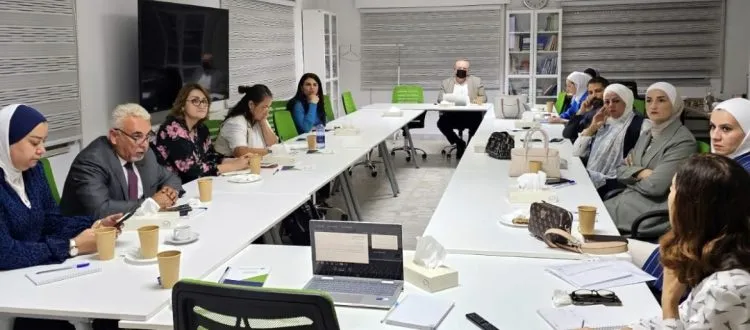
As the body of research expanded, something else was forming alongside it. The studies had been designed to answer questions about digital violence against women. But the process was also connecting women to one another.
Researchers who had spent years working within their own countries discovered colleagues wrestling with similar questions elsewhere. It’s not just that a new map was taking shape. What started as a collection of individual projects was becoming a community.
With support from IDRC, these women had opportunities to do something rare in the region: learn together across borders. Researchers and practitioners working in vastly different political and social contexts shared methodologies, compared findings, and tested ideas. Lessons from conflict-affected countries helped illuminate patterns that were less visible elsewhere. Legal analyses from one country informed work in another, allowing insight to accumulate rather than restart.
Differences between contexts remained important. But viewed alongside each other, those contexts became easier to unpack — and the regional shape of gendered digital violence became clearer.
Beyond researchers
The community was expanding in another way as well. Journalists, psychologists, women’s organizations, educators, legal experts, policymakers, and service providers were increasingly joining the conversation. The questions on the table were no longer confined to research. And as findings circulated across sectors and borders, so did relationships. A researcher in Jordan could reach out to a counterpart in Lebanon. A Tunisian journalist investigating blackmail could tap legal expertise elsewhere in the region. Organizations confronting new forms of abuse no longer had to begin from scratch.
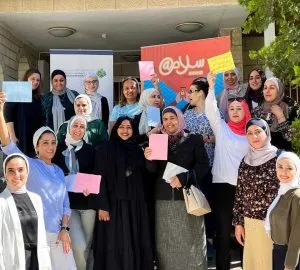
Salam@ also deliberately created spaces for relationships to grow. Leadership initiatives in Jordan and Tunisia convened community leaders and journalists eager to take action. Regional meet-ups brought together practitioners, researchers, and community leaders who might otherwise never have met. A partnership with the Arab Reporters for Investigative Journalism (ARIJ) made DVAW a standing theme for the world’s largest annual gathering of Arab journalists. The community was emerging through repeated opportunities to learn, collaborate, and build together.
By the time participants gathered at that seminal summit in Amman, the community was real. This was the product of several years of collaboration, exchange, and mutual learning. These women were no longer working alone.
A foundation of shared knowledge
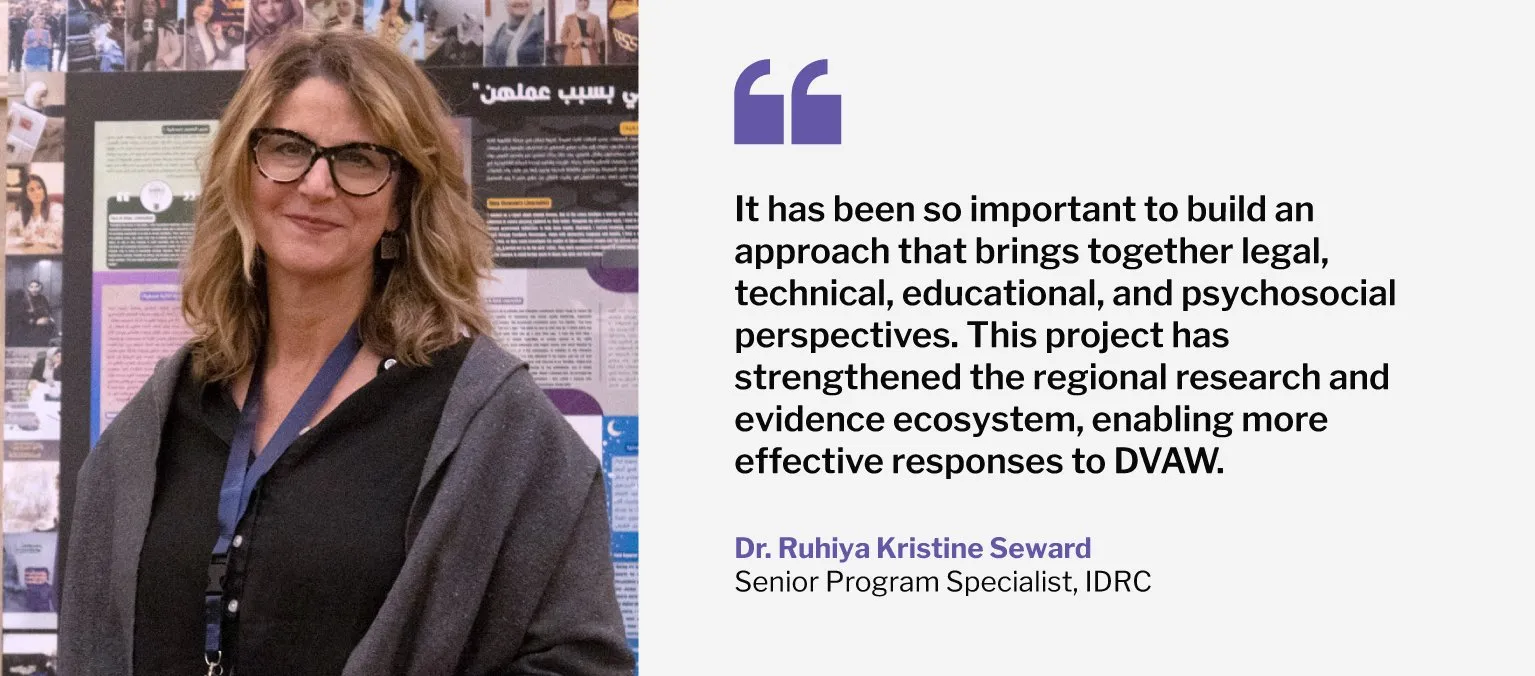
It has been so important to build an approach that brings together legal, technical, educational, and psychosocial perspectives. This project has played a critical role in strengthening the regional research and evidence ecosystem, enabling more effective responses to digital violence against women.Dr. Ruhiya Seward, Senior Program Specialist, IDRC

Communities that form through relationships endure through shared knowledge and culture. As researchers, practitioners, and organizations across the region began learning from one another, they were also creating something that had not existed before: a substantial library of Arabic-language evidence on digital violence against women.
The earliest studies set out to answer concrete questions from the field. But each new paper also laid groundwork for the next. Researchers built on each other’s findings and methods. New questions emerged from earlier work. Legal analyses informed institutional assessments. Psychosocial research highlighted gaps that future studies would explore.
Reading the growing body of work today, one feature stands out: these authors frequently cite each other’s latest work. While this may seem unremarkable, it reflects a profound shift. Researchers who had once worked in isolation are contributing to a regional conversation and evidence base.
Since 2021, the community has produced more than 40 country studies, legal reviews, and institutional assessments, along with manuals, toolkits, policy papers, and other practical resources. Most are available in English as well as Arabic. In some countries, these are the very first published data sets on DVAW. Together, they explore DVAW’s psychosocial, legal, and institutional dimensions — while documenting the complex experiences of women journalists, political candidates, activists, students, displaced women, and feminist organizations.
Since 2021:
- 40+ studies in 18 countries
- Legal and institutional assessments
- Psychosocial research
- Case studies
- Policy papers
- Practical manuals and toolkits
- Evidence on journalists, politicians, students, activists, displaced women, and more.
Collective memory
Many studies emerged collaboratively, drawing on the expertise of researchers, journalists, legal practitioners, psychologists, educators, and women’s organizations across the region. And now, for the first time, organizations seeking to respond to DVAW can draw on evidence generated within their own societies, languages, and realities. New researchers entering the field no longer begin with a blank page. Journalists, educators, and advocates can build on insight that already exists.
What we have here is more than a collection of publications. A community founded on need and built through relationships is recording its own collective memory. And that shared foundation is helping ideas move beyond research and into practical responses across the region.
Knowledge into action
Through this journey, evidence has been translated into guidance for practitioners, partnerships with universities, a community of practice, and clearer institutional pathways for responding to digital violence against women.Dr. Ayman Halasa, Information & Research Center – King Hussein Foundation

If the early years of this journey were defined by discovery, the years since have been defined by practical application. Knowledge generated through the growing DVAW community did not remain confined to reports and conferences. It began inspiring new initiatives, moving into institutions, and shaping responses across the region.
In mid-2022, women participating in a Salam@ leadership initiative in Jordan were discussing impacts of digital violence on female reporters. Among them was journalist Rania Sarayreh, who helped transform those conversations into action. By December, she had launched the Jordanian Network to Combat Digital Violence Against Female Journalists. Today, the network has more than 300 professional members, contributing advocacy, professional resources, and even their own new research to the MENA DVAW library.
Across the region, people who had first joined the community as participants were increasingly becoming leaders in their own right. For instance, Karak Castle Center emerged as one of Jordan’s leading voices on DVAW, convening researchers and practitioners and elevating the issue into national conversations. At the same time, a key insight was emerging both from the research and from the experience of these local partners. DVAW could not be addressed through awareness campaigns alone. Nor could it be solved through legal reform, digital security training, survivor support, policy advocacy, or education in isolation. The issue touched many systems at once.

This insight helped shape a new phase of IDRC-supported work for SecDev’s Salam@ team. Since 2024, the team has been testing an “ecosystems” approach to addressing DVAW in Iraq and Jordan — focused on strengthening institutions’ capacity to undertake a multifaceted response together.
One place this approach is already making a difference is in professional education. In Jordan, the Information and Research Center – King Hussein Foundation (IRC-KHF) has co-led efforts to embed DVAW response within educational institutions. Faculty from several universities co-developed a DVAW teaching guide to start embedding practical training into coursework. Law students from 10 universities recently participated in a national moot court competition built around a complex DVAW case, while journalism students produced podcasts grounded in survivor-centred reporting principles.
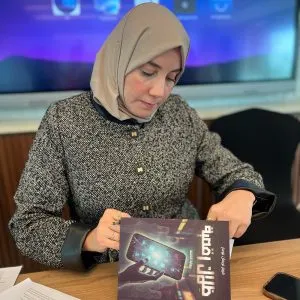
The conversation is reaching younger students too, especially through local partners bringing interactive activities into schools. For example, extraordinarily rich dialogue is being sparked by Digital Shadows, Meriem Noumeur’s youth novel about digital resilience — directly grounded in the DVAW research.
On another front, partnerships with organizations like Arab Reporters for Investigative Journalism (ARIJ) have used the research to inspire DVAW-aware storytelling that centres marginalized voices. A new co-published collection pulls together some of the most powerful stories flowing from that, featuring women journalists across eight MENA countries. ARIJ itself has been successfully advocating for policies within media institutions to better protect and support female employees.

Meanwhile, government actors, regulators, and professional bodies are increasingly participating in discussions about DVAW and how societies should address it. Local partners are directly engaging ministries, cybercrime units, and legal practitioners. Research from the community is informing policy conversations and emerging response mechanisms. Even where progress is uneven, the issue is appearing on agendas where it was once invisible.
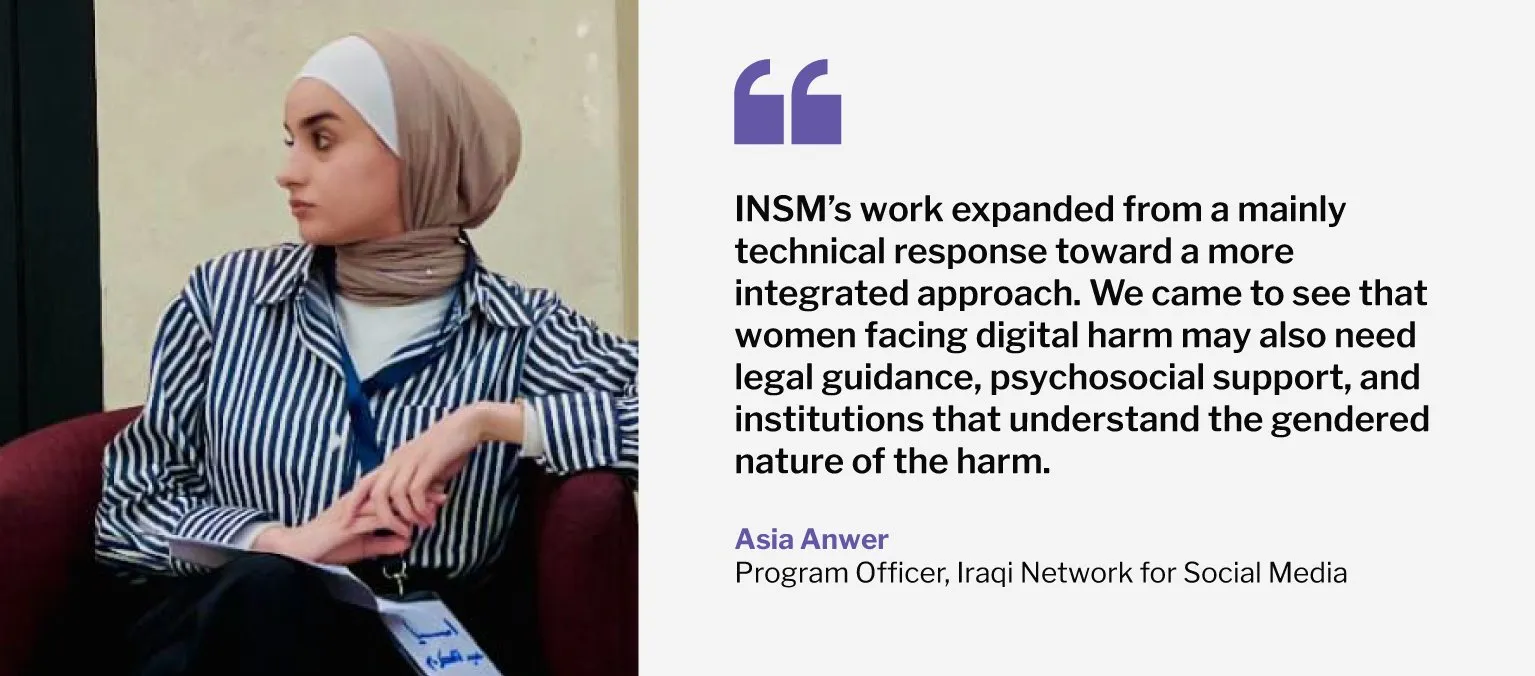
For example, Iraqi Network for Social Media research across 12 media institutions informed the country’s first code of conduct for journalists on digital violence, for review by the Communications and Media Commission. In Jordan, partnerships involving the Jordanian National Commission for Women, the Ministry of Political and Parliamentary Affairs, and the Ministry of Education are bringing digital violence into conversations about political participation, education, and institutional response.

Responding to survivors
This journey began with women seeking help from community organizations that often lacked tools to respond. Today, research is being translated into survivor-centred approaches that recognize digital violence not only as a technical or legal challenge, but as a psychosocial one as well.
We recently shared how Baghdad Women Association evolved from improvising support to delivering a structured response grounded in outreach, systematic intake, ethical documentation, and partner referrals. When BWA staff reflect on that growth, they often refer to “Dina’s story” as a defining moment.
 Dina, 16, is part of the Yazidi ethno-religious minority in the town of Shingal in Iraq. When she approached BWA, she was on the brink of desperation. Someone was circulating a sexualized photo of Dina on TikTok — devastating in her conservative community. BWA’s new psychosocial support officer helped her navigate the crisis and coordinated a supportive intervention with her family. At the same time, the organization looped in the INSM, which used its “trusted partner” status with TikTok to get the offending account removed.
But the story does not end there. After BWA, INSM, and Salam@ went public with Dina’s story, two Yazidi influencers took up the cause on Instagram. Soon hundreds of peers and survivors had come forward with similar accounts of digital exploitation. An INSM-led investigation revealed a web of coordinated attacks on Yazidi girls using stolen images, fake accounts, suggestive captions, and manipulated audio. Armed with analysis, INSM got to work.
Over the span of two months, they helped shut down more than 175 malicious accounts on TikTok, Facebook, and Instagram. Since then, INSM has continued helping shape TikTok’s regional approach to online safety, while BWA has expanded its digital safety awareness and training efforts for vulnerable communities. And Dina’s story became a powerful reminder: it takes a community to respond to digital violence against women and girls.
A legacy of change
From the start, we believed that local researchers, practitioners and institutions, working together, could build a response that would outlive any single grant or organization. What emerged is a regional community with the knowledge, relationships, and capacity to carry the work forward.Dr. Raed M. Sharif, MENA lead, SecDev Foundation

This journey has produced many publications, projects and partnerships, but its most enduring outcome is the community that has formed around them. Organizations that once sought guidance are now helping others respond. Institutions are beginning to centre DVAW in their own work. What began as an effort to understand DVAW has become a community increasingly capable of addressing it.
That community’s durability rests on something it lacked at the outset: a shared body of knowledge. Today, practitioners and researchers alike can draw on an Arabic-language library of studies, methodologies, legal analyses, and practical toolkits tuned to local realities. This is collective memory that others can inherit and build on.
Just as heartening is how people are carrying that knowledge forward. Researchers become mentors. Practitioners become trainers. Women joining the community to help document a problem find themselves helping others address it. Relationships forged through research evolve into ongoing habits of collaboration and peer support. Expertise that was once scattered across countries and sectors is more visible, connected, and accessible.
For insight or support, there’s always someone to call.



Carrying the work forward
In some places, institutions that shape public life are beginning to respond as well. With support, universities are starting to embed DVAW into professional training and awareness initiatives. Journalist networks are developing reporting initiatives and professional resources. Legal and psychosocial practitioners are producing tools, guidance, and support mechanisms for survivors. Government actors are participating in policy discussions and institutional responses.
Years of research revealed that DVAW could not be addressed through awareness campaigns, legal reform, digital security training, or survivor support alone. That’s why the ecosystem approach brings together:
- Governance
- Education
- Psychosocial support
- Digital resilience
- Media engagement
- Community action
But the movement’s centre of gravity remains an expanding core of community organizations across the MENA region. Drawing on the community’s research, expertise, and relationships, local partners have grown beyond their original project roles. These include organizations such as Baghdad Women Association, Karak Castle Center, the Information and Research Center – King Hussein Foundation, and the Iraqi Network for Social Media (INSM). Also the Jordanian Network to Combat Digital Violence Against Female Journalists — and many others across the region who have shaped this journey. Today, they are convening others, shaping national conversations, strengthening services for survivors, and pressing institutions to respond.
In the MENA region, the supportive ecosystem is still evolving. These are early days. But there is a growing web of relationships, institutions, knowledge, and leadership that now surrounds this critical issue. The promise of this ecosystem is not that every problem has been solved. It is that the capacity to respond is now more widely shared and more resilient.
Seven years ago, many of those working on the issue did not even know one another existed. Today, they are connected by shared evidence, tools, relationships, and a commitment to ensuring all women can participate safely and fully in public life. And very practically, more women facing digital violence have somewhere to turn — instead of facing the impacts alone.
Because the map that was once missing now exists.
And now there is a community to keep drawing it.
