

THE PHARMACY IN YOUR FEED
Medicines and supplements sold through social media in the Kurdistan Region of Iraq
Market scan • documented incidents • delivery apps • regulation • reporting harm
| MAIN FINDING
The Kurdistan Region has rules for licensed pharmacies and registered products, but no clear, publicly visible online-pharmacy system that connects social-media pages and delivery apps to licence checks, prescription verification, safe storage and rapid harm reporting. [1-4, 7, 10-17] |
Executive summary
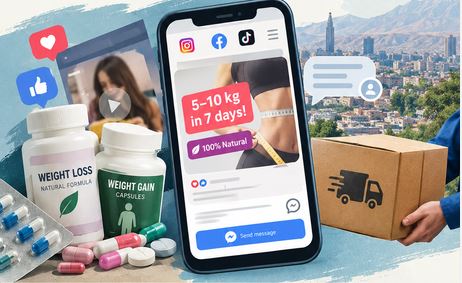
Medicines are now marketed in the same way as clothing or cosmetics: short videos, dramatic before-and-after claims, direct messages and home delivery. Recent Kurdish-language posts advertise weight-loss and weight-gain capsules, appetite products and other health products with promises such as “5–10 kg” loss or a “seven-day guarantee.” Older Facebook posts show the same sales method-comment with an address and phone number-has existed for years. [23-27]
This is a health risk, not simply an e-commerce issue. A buyer may not know whether the seller is licensed, whether a product is registered, whether the label is accurate, or whether a prescription medicine is safe for them. International regulators repeatedly find undeclared prescription drugs, banned chemicals or toxic ingredients in products sold as “natural” weight-loss or body-shaping supplements. Falsified versions of high-demand medicines, including semaglutide products, have also circulated internationally. [20-22]
Local evidence shows real harm. Families and consumers have described liver and intestinal injury, unwanted hair growth, sexual dysfunction and other complications after products bought through Facebook or other online sellers. In the best-known case, the family of 19-year-old Helin Ahmed said she died after taking “Mad Max” weight-gain pills bought through Facebook. Authorities opened an investigation; public reporting did not establish the pills as the medically confirmed cause of death. [7, 8]
Scope and method
This rapid desk review covers public or search-indexed content available up to 27 August 2026, with a focus on the Kurdistan Region. It examines social posts, local media, official rules and public delivery-app pages. It did not make test purchases, enter private messages or complete app checkouts. Therefore, “no visible prescription check” means no check appeared on the public page-not proof that no check happens later.
How the market works
- Discovery: a Reel or Facebook post uses body-image anxiety, testimonials, urgency and claims of fast results. [7, 23-27]
- Conversion: the buyer moves to a direct message, WhatsApp or phone call; medical history and drug interactions may never be discussed. [7, 27]
- Delivery: cash-on-delivery and courier apps reduce the need to visit a licensed pharmacy or speak to a pharmacist. [7, 10-15]
- Weak traceability: accounts can change names or disappear, while buyers may have no receipt, batch record or reliable seller identity. [7]
What is being advertised
The examples below are included as evidence, not endorsements. Claims are reported as written in public posts; they have not been medically verified.
| Public post | What the post promotes | Risk signal |
| Instagram • MySlim_IQ • 16 Aug 2026 [23] | Slimming pills; claims appetite suppression, fat burning and 5–10 kg loss. | Large, rapid result claim. |
| Instagram • Max capsules • 22 Jun 2026 [24] | Weight-gain capsules advertised with a seven-day guarantee. | Guaranteed result; no clinical assessment shown. |
| Instagram • Sultan Beauty Center [25] | A 60-capsule monthly slimming product. | Health product marketed through a beauty outlet. |
| Instagram • Pezhin Pharmacy [26] | Appetite and weight-gain softgels. | Body-change claim; prescription status unclear. |
| Facebook • Siva Shop (older post) [27] | “Jaguar” weight-gain pills sold retail/wholesale; asks for address and mobile. | Direct social-commerce order and delivery. |
Documented incidents in local reporting
- Helin Ahmed, Erbil (2021): her family told Rudaw that she took 36 “Mad Max” weight-gain pills bought through Facebook and later died after liver and intestinal damage. The Ministry of Health said a causal link had not yet been proven and launched an investigation. [8]
- Bahar Abdullah (reported 2023): Peregraf reported that the 21-year-old used online breast-enlargement pills with a Chinese label and later developed excess body hair and other health problems requiring specialist care. [7]
- Darian Kamal (reported 2023): Peregraf reported that an online “weight-loss coffee” was followed by loss of sexual function. [7]
Delivery apps: what the public evidence shows
| App | Medicine access | Public prescription control | Assessment |
| Lezzoo | Confirmed. The site advertises “prescriptions to your door” and lists thousands of pharmacy items. A public page displayed sildenafil 100 mg tablets as in stock. [10, 11] | No prescription-upload gate was visible on the public product page. Checkout was not tested. | Strongest evidence of actual medicines, not only cosmetics. |
| Amada | The app operates in Garmian/Kalar and Halabja; public Instagram promotion names a pharmacy partner. [12, 13] | No public medicine catalogue or prescription procedure could be verified. | Pharmacy presence is supported; pill sales remain unconfirmed in this review. |
| Talabat Iraq | A pharmacy has promoted availability on Talabat, but this does not prove that actual medicines-rather than beauty items-are sold. [14, 28] | Iraq terms describe a health-and-beauty vertical; no Iraq-specific prescription workflow was found. | Do not count as confirmed medicine access on present evidence. |
| Toters | The service operates in Kurdistan and its Butler feature can procure general items. [15] | No public pharmacy medicine list or prescription policy was found. | Not confirmed as a medicine seller in this review. |
Rules exist-but the online gap remains
- Health regulation: medicines must be registered through the Kurdistan Medical Control Agency, and companies, warehouses and pharmacies require licences. In August 2026, the KRG Ministry of Health repeated that medicines, herbal medicines and dietary supplements may be sold only through formal pharmacies and official drug warehouses; violations can lead to legal action and closure. [1, 2, 4]
- Enforcement: the KRG has introduced anti-counterfeit labels, inspections and sting operations. The Health Minister said dangerous weight-loss products advertised mostly online were being targeted. Local reporting describes dozens of arrests, but no regular public dashboard shows page removals, seizures, prosecutions or outcomes. [5-7]
- Communications law: KRI Law No. 6 of 2008 can be used against harmful misuse of communications, and local legal commentary says fraudulent medicine sellers may be charged under it. It was not designed as an online-pharmacy law and does not create prescription, storage or delivery standards. [7, 9]
- Platform rules: Meta prohibits private individuals and retailers from buying, selling or trading pharmaceutical drugs and restricts prescription-drug advertising. TikTok’s June 2026 Iraq ad policy does not list weight-loss supplements among permitted weight-management products. The continuing public posts show an enforcement gap, especially for organic content, Kurdish/Arabic wording and sales moved to private messages. [16, 17, 23-27]
| REGULATORY CONCLUSION
The Ministry of Health-not the communications ministry-is the main medicine regulator. No dedicated, publicly accessible KRI rule was found that requires delivery apps or social pages to display a pharmacy licence, validate prescriptions, preserve pharmacist review records or publish adverse-event data. [1-4, 7, 10-17] |
If harm occurs: a practical reporting path
- Seek care first. Severe symptoms-fainting, breathing difficulty, chest pain, seizures, heavy bleeding, confusion or rapid deterioration-require emergency care. Do not wait for the seller to reply.
- Preserve evidence. Keep the package and remaining product; photograph the label, batch, expiry date and KRG Ministry sticker. Save screenshots, account URL, messages, phone number, order record, payment and courier details.
- Report the health event. The Iraqi Pharmacovigilance Center accepts reports from patients and caregivers through its online form, including side effects, product-quality problems and medication errors. A complaint about public or private health services can also be filed through the KRG Ministry of Health service. [2, 18, 19]
- Report the listing separately. Use the platform or app’s report/support tool and give the same evidence. A content report helps remove a listing; it does not replace medical treatment or an adverse-event report. [16, 17]
Priority actions
The KRG should create a searchable register of pharmacies allowed to sell online; require licence display, pharmacist review and prescription upload for prescription-only medicines; make apps record the seller, prescription decision, batch and courier hand-off; publish quarterly enforcement data; and offer one Kurdish/Arabic complaint route linking health, consumer-protection and digital-platform reports. Platforms should strengthen Kurdish and Arabic detection for “guaranteed” weight change, hormone and sexual-enhancement claims and keep repeat sellers from reopening. Delivery apps should publicly state exactly which products require a prescription and what happens when one is missing.
Bottom line
Buying a shampoo from a pharmacy category is ordinary e-commerce. Buying a medicine or medically presented supplement without a verified seller, product registration and appropriate prescription check is different: the consumer carries the health risk while the seller and platform may remain hard to trace. The quickest protection is to connect every online sale back to a licensed pharmacy and accountable pharmacist.
References
All links were accessed on 27 August 2026. Public social-media posts may later change or be removed.
