

1. Introduction
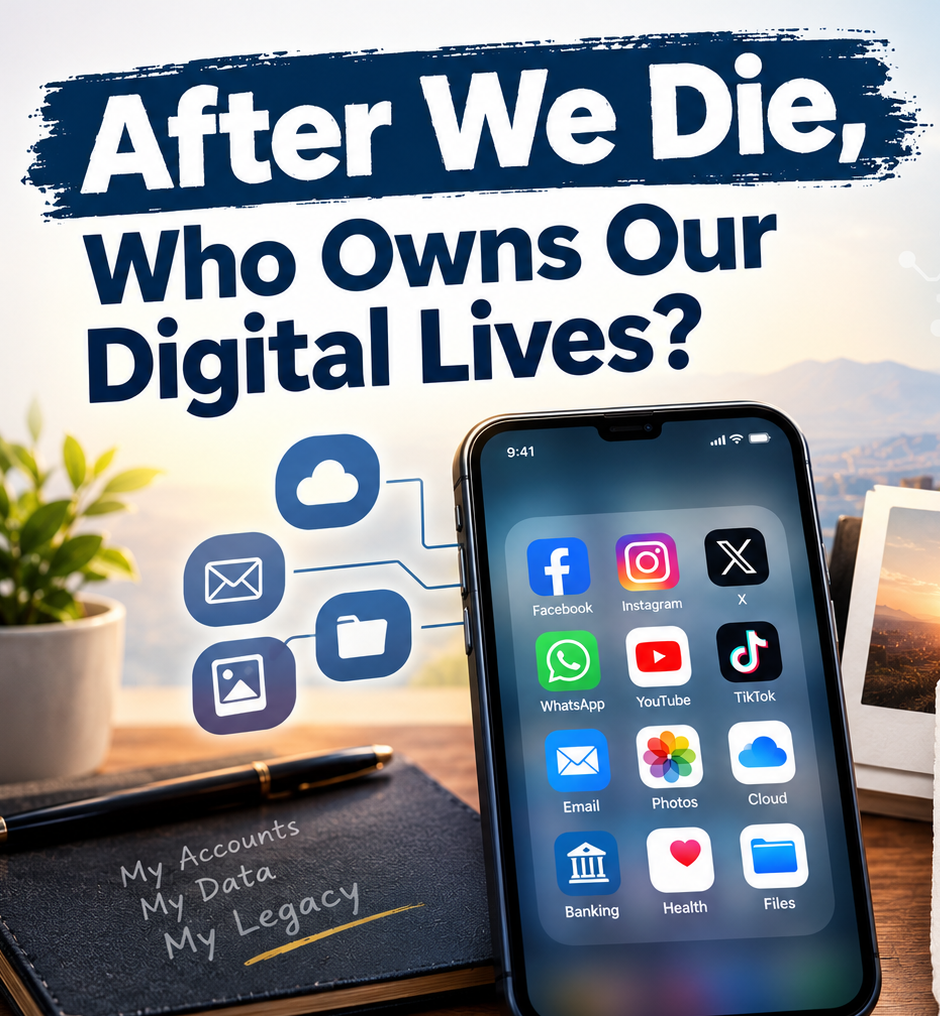
Imagine a family whose member dies unexpectedly. their smartphone contains thousands of photographs, his Gmail account holds years of work correspondence, Google Photos stores family videos, and a YouTube channel generates monthly advertising income. His children arrange the funeral and gather his belongings. Someone picks up his phone.
What can the family do next? That depends on six very different things: whether they know his passcode, whether he used cloud backups, whether each online service recognises the right to pass an account to heirs, whether Iraqi or Kurdistan Region law gives them authority, whether a court could compel a foreign company to act, and whether the family has the right documents. Owning the phone is not the same as owning everything inside it. This report maps each of those distinctions for families in Kurdistan Region.
2. What Forms Part of a Digital Life?
Six categories should be considered separately, because each follows a different legal and technical path.
- The phone: a physical object that can pass to heirs as personal property under Iraqi and Kurdistan civil-law rules.
- Locally stored files: photographs, voice notes, documents and messages saved to the device memory. A reset erases them. A backup may allow recovery.
- The account: a contract or permission to use a service. Most platform terms state that the account is personal and non-transferable. Holding the password is not the same as holding a right.
- The money: advertising revenue, creator payments, domain income, subscription refunds and other monetary claims may be estate assets subject to inheritance rules, but the platform still controls verification and payment.
- Private content: messages and photographs may involve living people. Reading them can create ethical, legal and confidentiality concerns even for heirs.
- The platform action: memorialization, deletion, data disclosure and account transfer are four distinct outcomes, available at different platforms, for different reasons, with different documents.
No single step – not even obtaining a court order – automatically achieves all of these outcomes. Families should treat each category as a separate question.
3. Social-Media and Messaging Platforms After Death
Policies change frequently. All links below were verified on 3 September 2026. The table presents a compact comparison; the notes after the table add important detail for the Kurdistan Region.
| Platform | Option after death | Who may submit? | Required documents | Can relatives receive data? | Account access / transfer? | Official request link |
| Memorialization or deletion.
Legacy contact manages memorialized profile (cannot log in, reset pw or read private messages). |
Immediate family, friend or any person with sufficient proof. [1] | Proof of death (death certificate); relationship proof; requester ID. Court order not required but may help. [1][2][3] | Limited: photos and posts visible on memorialized profile. No private messages provided. [4] | No login, no password. Account not transferred. [1] | facebook.com/help/1568013990080948 | |
| Messenger | No separate policy; governed by Facebook rules. Private Messenger conversations are not provided even to a legacy contact. [4] | As Facebook above. | As Facebook above. | No. End-to-end encrypted chats cannot be read by Meta. [4] | No transfer or login access. | facebook.com/help/275013292838654 |
| Memorialization or removal. No legacy-contact feature on Instagram. [5][6] | Immediate family or authorized representative. [5] | Proof of death; relationship; requester ID. [5][6] | No login access; private content not provided. Visible posts remain on memorialized profile. [7] | No transfer. No password provided. [5] | help.instagram.com/264154560391256 | |
| Account deletion only. No memorialization. No data transfer. Deletion is irreversible. [8] | Immediate family member or authorized legal executor with official documentation (death certificate and proof of relationship). [8] | Death certificate; proof of relationship; proof of legal authority (executor). WhatsApp verifies documentation before acting. [8] | No. End-to-end encryption means WhatsApp cannot read or provide messages. Local backups on the device or in Google Drive/iCloud may exist. [8] | No access, no transfer, no password reset provided. [8] | faq.whatsapp.com/2138577903196467 | |
| Threads | No separate policy located. Governed by Instagram/Meta rules. [5] | As Instagram. | As Instagram. | No specific data-download provision located. | No transfer. | help.instagram.com/264154560391256 |
| X (Twitter) | Immediate family or estate representative may request deactivation and removal. No memorialization feature. [9] | Immediate family member or estate representative with official proof. [9] | Requester name; proof of relationship or estate authority; proof of death; username; government-issued ID. [9] | No. X does not provide private message logs, login credentials, or downloadable data archives to heirs. Deactivation and profile removal only. [9] | No login, no transfer, no data archive for heirs. Account deactivated then permanently deleted after 30 days. [9] | help.x.com/en/rules-and-policies/account-deceased |
| TikTok | Family members may request removal or memorialization of a deceased person’s account. [10] | Immediate family member or legal representative. [10] | Proof of death; proof of relationship; requester ID; account details. [10] | No content download option confirmed in public policy. [10] | No login or transfer provided. [10] | support.tiktok.com/en/safety-hc/account-and-user-safety/report-a-deceased-users-account |
| Snapchat | Account deletion on verified request from immediate family. No memorialization. [11] | Immediate family or legal representative. [11] | Full legal name; Snapchat username; death certificate; requester ID; relationship proof. [11] | No data provided. Snaps are deleted by design after viewing. [11] | No login or transfer. Deletion is permanent. [11] | support.snapchat.com/en-US/a/deceased |
| Viber | No publicly documented deceased-user policy located. Account becomes inactive. [Note] | No official process published. | No official policy located. | No. End-to-end encryption; Viber states it does not have access to message content. [12] | No official transfer or access procedure located. | help.viber.com |
| Telegram | Account auto-deleted after 6 months of inactivity (user may set 1, 3, 6, or 12 months). No family notification process. [13] | No official family request channel. [13] | No official process published. | No. Secret Chats use end-to-end encryption; Telegram states it cannot access these. Cloud chats are encrypted but held on Telegram servers. [13] | No transfer. Account auto-deletes on inactivity. [13] | telegram.org/faq#q-what-happens-if-i-forget-my-password |
| Google / Gmail / Drive / YouTube | Inactive Account Manager (IAM) can share selected data or delete account. Family may submit a bereavement request even without IAM. [14][15][16] | Account holder (via IAM before death) or family/representative after death. [14][16] | Death certificate; requester ID; proof of relationship; account details. Google may ask for additional documents. Court order may be required for full content access. [16] | Possible via IAM (photos, Drive files, Gmail, YouTube data). Without IAM, Google reviews individually and does not promise access. YouTube creator income is a separate review. [14][15][16] | No login or password. Account not transferred. [14] | support.google.com/accounts/troubleshooter/6357590 |
| Apple / iCloud | Digital Legacy contact may request access. Deletion also available. Locked device cannot be unlocked without erasing it. [17][18] | Designated Digital Legacy contact (if set before death); otherwise legal representative with a court order. [17] | Legacy access key (if set before death) plus death certificate; or court order designating the requester as the legal heir. [17] | Yes, if Digital Legacy was set up. Includes photos, contacts, notes, mail. Does not include App Store purchases, subscriptions, or passwords stored in iCloud Keychain. [17] | Temporary access only; no password provided; device with unknown passcode cannot be unlocked without erasing. [17][18] | support.apple.com/en-us/102431 |
| Dropbox | Bereaved-family access request exists. Requires a court order compelling disclosure. [19] | Immediate family or legal representative. [19] | Requester’s name, address, relationship; deceased’s account email; requester government ID; valid court order compelling Dropbox to disclose. [19] | Possible if court order obtained; Dropbox reviews and does not guarantee access. [19] | No login, no password. Access dependent on court order. [19] | help.dropbox.com/account-settings/access-account-of-someone-who-passed-away |
| Microsoft / OneDrive / Outlook | Family request exists. OneDrive Digital Legacy may offer read-only access where available. Outlook/email generally requires legal process. [20][21] | Family member or authorized legal representative. [20] | Death certificate; requester ID; proof of relationship. Full account content (personal email, OneDrive) generally requires a valid court subpoena. [20] | Possible for OneDrive files where Digital Legacy is available; personal email generally requires legal process. [20][21] | No login or password provided. [20] | support.microsoft.com (deceased account) |
Note on encryption and private messages. WhatsApp uses end-to-end encryption by default, meaning messages are encrypted on the sender’s and recipient’s devices. Meta cannot read or hand over WhatsApp message content. Messenger’s end-to-end encrypted conversations are similarly inaccessible to Meta. Telegram’s “Secret Chats” are end-to-end encrypted and deleted when the chat is closed; regular cloud chats are encrypted in transit and stored on Telegram servers but are not accessible to families without a court order directed at Telegram, which does not have a published family-request process. Viber applies end-to-end encryption to calls and 1-to-1 messages and states it does not hold message content. [12][13]
A note on creator income. Google/YouTube AdSense earnings that have not been paid out when the account holder dies may be claimed by legal heirs through Google’s bereavement-payment process [15][16], subject to identity and tax documentation. TikTok and Snapchat creator-fund earnings: no published process was located for heirs claiming outstanding amounts. X (Twitter) and Meta have not published a specific heir-payment process for creator income. Families should treat outstanding creator income as a potential estate asset and seek legal advice.
4. Cloud Storage and What Happens When Payments Stop
Most cloud-storage services tie the storage quota to a paid subscription. When the account holder dies and payment stops, the process is generally gradual, not immediate.
Google Drive / Google One. Google states that when an account is over its storage quota, users cannot upload new files, send or receive Gmail, or back up photos and videos. After two years over quota, Google may delete content. Google says it will send notices at least three months before any eligible deletion and offer the user an opportunity to pay, remove files or download data. [22] Family members cannot continue a paid Google One subscription on behalf of a deceased account holder without access to that account. The Inactive Account Manager can be set before death to notify a trusted contact and share data automatically. [14]
Apple iCloud and iCloud+. When an iCloud+ subscription is cancelled or payment stops, Apple advises users to download or remove content exceeding the new free-storage amount (5 GB). Some features become unavailable after downgrade. Apple does not specify a deletion timeline for existing data that exceeds the free tier, but content above 5 GB may no longer sync or be accessible until the storage situation is resolved. [23] A Digital Legacy contact’s temporary access does not transfer the subscription. [17]
Dropbox. Dropbox states that files may eventually be deleted to bring an over-quota account under its limit, with notice provided beforehand. [24] Accessing a deceased person’s Dropbox requires a court order (see Table 1).
Microsoft OneDrive and Microsoft 365. Microsoft’s deceased-account policy focuses on account data rather than billing continuation. Personal Microsoft 365 subscriptions are non-transferable. OneDrive data access requires the family request or legal process described in Table 1. [20][21]
Huawei Cloud, Samsung Cloud and Xiaomi Cloud. No Kurdistan-specific evidence was located for Huawei Cloud (pcloud.huawei.com) or Xiaomi Cloud (mi.com/cloud) post-death processes. Samsung Cloud was discontinued in 2021, with data migrated to OneDrive or the device. [25] For Huawei and Xiaomi, families should contact the manufacturer’s local or regional support channel and expect to provide a death certificate, proof of relationship and account details; a court order may be required.
Important: Paying a subscription from another account does not transfer ownership. Authentication (username and password) and legal rights to the account remain separate from payment capacity.
5. Phones, Encryption and Data Recovery
5.1 The Critical Difference Between Actions
The following table shows what each action achieves and what it does not achieve.
| Action | What it achieves | What it does NOT achieve |
| Unlocking the phone (passcode known) | Access to locally stored files, apps and accounts already logged in | Passwords to individual accounts; access to end-to-end encrypted messages; rights to continue using those accounts |
| Resetting / factory reset (passcode unknown) | Restores device to usable state | Does NOT recover locally stored data – it permanently erases it. Does not bypass cloud-account locks. [26] |
| Restoring from cloud backup (Google/iCloud) | Recovers photos, contacts, settings backed up before death (if family knows account credentials or uses official bereavement process) | Does not bypass the account’s authentication requirements [17][14] |
| Official bereavement process with the platform | Possible access to certain cloud data, photos, or selected content (varies by platform) | Not guaranteed; does not provide passwords; does not give full account login [1][5][14][17] |
| Court order (Iraqi court) | May compel an Iraqi or Kurdistan Region court decision; may persuade a cooperative platform | Does not automatically bind an international platform operating under US/EU law; encrypted data cannot be produced even by the platform [13][17] |
5.2 Biometric Access, Encryption and Activation Lock
Most modern phones support fingerprint recognition (Touch ID on Apple; fingerprint on Android devices), facial recognition (Face ID on Apple; face unlock on Android), PIN, passcode and pattern lock.
After a restart, a security timeout or a failed biometric attempt, most devices require the passcode, not biometric data. This means that using a deceased person’s finger or face to unlock the phone may not work if the phone has restarted or if biometric timeout has expired. A local technician or repair shop has no legitimate way to bypass this and the passcode without either knowing the passcode or performing a factory reset (which erases data).
End-to-end encryption (used by WhatsApp, Messenger’s encrypted chats, Telegram Secret Chats, Viber and Apple’s iMessage) means that the platform’s servers hold only encrypted data. The platform cannot read the content and cannot provide it even with a court order. The only readable copy may exist on the device itself. If the device is locked and the passcode is unknown, that copy may also be inaccessible. [12][13]
Activation Lock (Apple) and Factory Reset Protection (Android) are designed to prevent an unauthorized person from using a device after a reset. Apple’s Activation Lock is tied to the Apple ID. If the family does not have the Apple ID credentials and the Digital Legacy process has not been followed, the device may remain in a locked, non-recoverable state. [17][18] Google’s Find My Device and Factory Reset Protection similarly tie the device to a Google Account, and a factory reset without the account credentials will leave the device locked. [26]
Families should not use unauthorized methods to bypass these systems. Such attempts may permanently destroy the data and may violate Iraqi Penal Code No. 111 of 1969 (Article 437 on tampering with correspondence) and the rights of living correspondents whose messages may be on the device.
6. Manufacturer and Operating-System Policies
The following table covers the most widely used phone platforms in the Kurdistan Region, based on publicly available information verified on 3 September 2026.
| Company / system | Deceased-user or legacy option | Can it unlock a locked device? | Can relatives request cloud data? | Documents required | Official support link |
| Apple iOS / Apple Account / iCloud | Digital Legacy contact may be set before death. Apple Support can be contacted after death.
Device with unknown passcode cannot be unlocked – it must be erased. [17][18] |
No. Unknown-passcode device must be erased (data lost). [18] | Yes, through Digital Legacy (if set) or bereavement request. Court order may be required. [17] | Death certificate; Legacy access key (if set); or court order designating heir. Requester ID. [17] | support.apple.com/en-us/102431 |
| Android / Google Account | Inactive Account Manager (IAM) may be pre-set. Family bereavement request available. Factory reset erases all data. [14][26] | No. Factory reset erases data. Google cannot unlock a specific device remotely. [26] | Possible through Inactive Account Manager or bereavement request. Varies by evidence provided. [14][16] | Death certificate; requester ID; proof of relationship; Google account details. [16] | support.google.com/accounts/troubleshooter/6357590 |
| Samsung (Android with One UI) | Samsung Cloud discontinued 2021. Samsung devices run Android; Google account policies apply. Samsung does not have a separate deceased-user unlock service for devices. [25] | No specific Samsung unlock service for deceased users. Contact Samsung Support for case-by-case review. | Samsung Cloud data was migrated to OneDrive in 2021. OneDrive rules apply. [25] | As Google/Android above plus Samsung account details if separate Samsung account was used. | samsung.com/global/galaxy/apps/samsung-account/ |
| Xiaomi (MIUI / HyperOS) | No publicly documented deceased-user process located for Mi Account or Xiaomi Cloud. Contact Xiaomi Support directly. [27] | No published policy located. | No published deceased-user cloud policy located. Contact Xiaomi Support. | Likely: death certificate, ID, proof of relationship – but no official list published. | account.xiaomi.com / mi.com/service/support |
| Huawei (EMUI / HarmonyOS) | No publicly documented deceased-user process located for Huawei ID or Huawei Cloud. Contact Huawei Support directly. [28] | No published policy located. | No published deceased-user cloud policy located. | Likely: death certificate, ID, proof of relationship – but no official list published. | consumer.huawei.com/en/support/ |
Important distinction. Apple and Android (Google) are operating-system and cloud-account providers with published bereavement procedures. Samsung, Xiaomi and Huawei are device manufacturers who run their own additional account services alongside the core operating system. Policies at the manufacturer level (Samsung Account, Mi Account, Huawei ID) are separate from the Google Account running on the same device. Families may need to contact both Google and the manufacturer.
7. Iraqi Mobile-Network Operators
Iraqi mobile-network operators (MNOs) are separate from phone manufacturers, operating systems and applications. The MNO holds the SIM contract, the phone number and the right to transfer or reassign it. Three main MNOs operate in the Kurdistan Region.
| Operator | SIM transfer to relative? | Number reassignment risk | Call/SMS records access | Documents typically required |
| Asiacell | Number transfer to a relative is generally possible at a customer-service centre. Family members should contact the nearest Asiacell store. [29] | Inactive or non-paying numbers may eventually be reassigned. A reassigned number could receive password-reset SMS messages intended for a deceased user’s accounts. [29] | Call and SMS records are held by the operator and may require a court order or official request through Iraqi security or judicial channels. Not routinely provided to families. [30] | Death certificate; family-status document (hujja); requester national ID; account contract details. |
| Korek Telecom | Transfer may be possible through customer service. Contact Korek directly. [31] | Same risk as above – reassignment of inactive numbers. [31] | As above – court order or formal legal channel expected. [30] | As above. |
| Zain Iraq | Transfer may be possible through customer service. Contact Zain directly. [32] | Same risk. [32] | As above. [30] | As above. |
Critical warning on phone-number reassignment. If a deceased person’s phone number is reassigned to a new customer, that new customer may receive one-time passwords and password-reset messages for the deceased’s online accounts. Families should transfer or cancel the number promptly. This is a significant security risk for accounts still linked to that number, including bank and payment services. [29][32]
A court order issued by a Kurdistan Region or Iraqi federal court may request call records or account information from an Iraqi MNO, which operates under Iraqi jurisdiction. This is different from attempting to use an Iraqi court order to compel a foreign platform.
8. Iraqi and Kurdistan Region Law
There is no enacted Iraqi or Kurdistan Region law specifically governing digital inheritance, post-mortem access to social-media accounts, cloud data after death, or transfer of online accounts as of 3 September 2026. Several general laws, however, are relevant.
8.1 The Iraqi Constitution 2005
Article 17(First) [Full text]. The individual shall have the right to personal privacy so long as it does not contradict the rights of others and public morals. This protects personal privacy as a constitutional right, including – by natural extension – private correspondence and personal digital content.
Article 40(First) [Full text]. Freedom of communication and correspondence – postal, telegraphic, electronic and telephonic – shall be guaranteed and may not be monitored, wiretapped, or disclosed except for legal and security necessity and by a judicial decision. These provisions protect private communications during a person’s lifetime and suggest that access to a deceased person’s private messages by heirs is not automatic and may require judicial authority. [33]
8.2 The Iraqi Civil Code No. 40 of 1951
Articles 61–70 (Preliminary Title, Chapter 1, Section 3 – Things and Property / الأشياء والأموال) [Cyrilla Database – Iraqi Civil Code]. These are the foundational provisions governing what constitutes property under Iraqi law. Article 61 defines commercial property (المال) as anything that can be owned and benefited from lawfully. Article 62 distinguishes movable (المنقول) from immovable (العقار) property: a phone as a physical device is movable property and may pass to heirs. Article 70 explicitly recognises intangible or moral rights (الأموال المعنوية) – such as intellectual property rights and other non-physical entitlements – as a category of property. This is the closest statutory basis in the Civil Code for arguing that monetised digital rights (such as creator income or intellectual property in digital content) may constitute estate assets. However, the Civil Code does not address online accounts, cloud storage or social-media profiles. [34]
Note on Article 88. Article 88 of the Civil Code governs contract formation between parties not physically co-present (التعاقد بين الغائبين), such as contracts concluded by telephone or remote communication. It is a contracts provision, not a property-definition article, and is not the correct basis for digital inheritance analysis.
Article 1103 et seq. (Inheritance provisions within the Civil Code). The Civil Code recognises inheritance of property by lawful heirs. Monetary claims – such as creator income held by a platform – may qualify as estate assets if they constitute a debt owed to the deceased, but this requires legal interpretation.
8.3 Iraqi Personal Status Law No. 188 of 1959
Articles 86–93 (Inheritance) [sjc.iq]. This law governs who inherits property in Iraq and applies in the Kurdistan Region. It establishes inheritance shares for spouses, children and parents. A phone and – arguably – financial claims connected to an online account may fall under these provisions. The law does not specifically address digital content or online accounts. [35]
8.4 Law of Electronic Signatures and Electronic Transactions No. 78 of 2012
Article 2 (Definitions): defines “electronic transaction” broadly to cover exchanges and dealings carried out electronically. Article 3 (Scope of Exclusion): explicitly excludes personal-status matters, wills, waqf (charitable endowment) and inheritance transactions from the law’s scope. This is important: it means that Law No. 78 of 2012 cannot be invoked as the legal basis for digital inheritance or post-mortem account access. [Full law ] [36]
8.5 Iraqi Penal Code No. 111 of 1969
Article 437 [sjc.iq]: Criminalises opening or accessing private correspondence without authorisation. While this applies primarily to living persons’ correspondence, it is worth noting that unauthorized access to a deceased person’s messages – particularly where living correspondents are involved – could engage this provision if the living correspondent objects. [37]
Article 438 : Criminalises disclosure of a private secret obtained by reason of one’s profession or position. A technician who accesses a deceased person’s device and discloses private content could potentially be liable under this provision. [37]
8.6 Kurdish Media and Cybercrime Framework
The Kurdistan Region enacted the Kurdistan Region Journalist Protection Law No. 6 of 2007 [Law 6/2007], which includes provisions protecting communications of journalists. This does not create a digital-inheritance framework, but demonstrates that the Kurdistan Region legislature has addressed media and communications rights.
At the federal level, Iraq’s draft Cybercrime Law has been discussed since at least 2017 but had not been enacted in a form specifically addressing digital inheritance as of the research date. Families should seek current legal advice from a qualified Iraqi or Kurdistan Region lawyer, as legislation may progress.
8.7 Practical Legal Conclusion
Key conclusion. No reliable publicly available Iraqi or Kurdistan Region law or court decision specifically addressing the transfer, inheritance or post-mortem access to social-media accounts, cloud storage, private messages or online income was located during this multilingual search. The absence of an online source is not proof that no dispute has arisen; it reflects a documentation and access gap. Families should obtain qualified legal advice and use official platform procedures rather than attempting self-help access.
Even where a Kurdistan Region court issues an order, it does not automatically bind an international platform (Facebook, Google, Apple, TikTok). These companies typically require legal process in their own jurisdiction (United States, European Union, Ireland) or follow their internal law-enforcement or user-request channels, which are governed by their own terms of service and data-protection obligations.
9. Religious, Cultural and Ethical Concerns
9.1 Islamic Scholarly Discussions
No identified official fatwa from a Kurdistan Region religious authority specifically addressing digital inheritance was located during this research. The following reflects scholarship and rulings from recognized Islamic institutions.
The Jordanian General Iftaa Department (Dar al-Ifta Jordan) has considered the ruling on social-media accounts after death. Its published position states that heirs should not use or possess the deceased’s social-media account in a way that violates privacy or causes harm, while recognising the importance of the deceased’s personality, reputation and continuing good works. [38] This is a formal fatwa from an official body, not a binding ruling in Kurdistan, but it is an authoritative Sunni Islamic reference.
Islamic inheritance jurisprudence (fiqh al-mawārīth) classifies estate assets as physical and financial. Contemporary Arabic and Islamic legal scholarship – including peer-reviewed research – commonly distinguishes between:
- Monetised creative or intellectual rights (e.g., YouTube revenue, a published work): these may qualify as estate assets analogous to intellectual property rights and may be inherited. [39]
- Private correspondence and intimate personal content: protecting the deceased’s secrets (sitr al-mayyit) and dignity after death is a recognised Islamic principle. Accessing and sharing private messages without necessity is widely considered impermissible. [38][39]
- Harmful or impermissible content: content that was unlawful during the person’s lifetime (e.g., defamatory, sexually explicit or religiously prohibited material) should be deleted, not inherited or published. [39]
- Beneficial content: charitable knowledge content that continues to benefit others (sadaqa jāriya) may be preserved; this is an established Islamic principle. [38]
These are scholarly positions, not a single binding local fatwa. Families seeking religious guidance in the Kurdistan Region are advised to consult their local mufti or recognized religious council.
9.2 Cultural Practices and Public Awareness
Research into Kurdish-language news sources, social-media discussions and public reporting did not uncover a reliable survey of how families in Erbil, Sulaimaniyah, Duhok, Halabja, Garmian or Raparin handle digital accounts after death. Individual online examples exist – families posting death announcements from the deceased’s account, maintaining memorial profiles, or losing access to photographs when cloud payments stop – but these examples cannot be treated as representative of the whole community without reliable survey evidence.
The limited accessible local coverage itself indicates an awareness and guidance gap. Families across the Kurdistan Region may face platform bereavement procedures that are only available in English, with no Kurdish-language guidance, no local case law and no civil-society publication specifically addressing these questions.
Identified concern: phone-number reassignment. There is a specific risk in the Kurdistan Region that an Iraqi MNO will reassign a deceased person’s number to a new customer, potentially enabling that customer to receive password-reset messages for the deceased’s bank, social-media and other accounts. This risk is not specific to any community; it reflects a systemic gap between telecom practice and digital-account security.
10. International Case Studies
Germany, 2018–2020 – Federal Court of Justice (BGH), III ZR 183/17
A mother sought access to her deceased teenage daughter’s Facebook account to determine whether she had been bullied before dying. Facebook refused, citing telecommunications confidentiality. The BGH ruled in 2018 that a Facebook user agreement passes to heirs in the same way as other contracts under § 1922 of the German Civil Code (BGB) – the principle of universal succession (Gesamtrechtsnachfolge). Privacy and telecommunications law did not prevent access to the account’s contents as they existed at the time of death. In 2020, the BGH clarified that the heir’s access should be equivalent to what the deceased had, except for active posting. [40][41]
Relevance to Kurdistan Region families. This case shows how a clear statutory succession rule (universal succession) can resolve a digital-inheritance dispute. Iraq’s Civil Code and Personal Status Law establish inheritance but do not contain an equivalent provision addressing digital contracts. The German judgment does not apply in Iraq, but it suggests that a future Iraqi or Kurdistan Region amendment to the Civil Code explicitly extending succession to digital accounts could resolve the current legal gap.
United States, Michigan, 2005 – In re Ellsworth (Oakland County Probate Court)
The father of a US soldier killed in Iraq sought access to his son’s Yahoo email account. Yahoo refused, citing its terms of service. An Oakland County Probate Court ordered Yahoo to provide the account’s email contents on CD-ROM and in print. [42]
Relevance. This case demonstrates both the power and the limits of a domestic court order: a probate court could compel a domestic service provider, but the process required litigation and produced a data copy rather than full account access. A Kurdish or Iraqi family seeking email contents from Google, Yahoo or Microsoft would need to engage that platform’s law-enforcement or legal-process channel, which operates in the United States, not in Iraq. A Kurdish court order is not automatically recognised.
United States, 2016 – Apple v. FBI, San Bernardino Encrypted iPhone
Following the 2015 San Bernardino shooting, US federal investigators sought a court order compelling Apple to create software to unlock an iPhone. Apple opposed the order on security and precedent grounds. The FBI withdrew the request after obtaining the data through a third party. [43][44]
Relevance. Even a court order from a US federal court did not guarantee that Apple would, or could, unlock an encrypted device. For Kurdish families in possession of a locked iPhone, a local court order is even less likely to produce a result: the device’s encryption is hardware-enforced, and without the passcode, the only Apple-endorsed option that does not destroy the data is the Digital Legacy process established before death.
11. Local Information and Legal Gaps
The following gaps were identified during this research.
- No enacted Iraqi or Kurdistan Region law specifically governs digital inheritance, post-mortem account access, cloud-data disposal or online income after death.
- No publicly accessible Kurdistan Region or federal Iraqi court decision on digital account access after death was located.
- No Kurdish-language (Sorani or Kurmanji) guidance from a government body, civil-society organisation or major platform was located for families in Erbil, Sulaimaniyah, Duhok, Halabja, Garmian or Raparin.
- No Arabic-language platform guidance specifically tailored to Iraqi families was located.
- No official Kurdish or Iraqi religious ruling (fatwa) on digital inheritance from a local institution was located.
- Huawei, Xiaomi and Samsung do not have publicly documented post-death account processes for the Kurdistan Region or Iraq.
- Iraqi mobile-network operators do not have publicly documented policies on number transfer to deceased persons’ heirs that were accessible for this research.
- No reliable survey data on Kurdish families’ digital-inheritance practices or awareness was located.
These gaps are consequential. Families facing a digital bereavement must navigate international platform rules in a foreign language, with no local legal framework, no local court precedent and no civil-society guidance written for their context. The cost – financial, emotional and in lost evidence – can be significant.
Five Steps to Protect Your Digital Life
Take these steps while you are alive. Digital accounts cannot be reliably inherited without prior planning.
Step 1. Review legacy and inactive-account settings now. Facebook, Google and Apple all offer settings that allow you to name a trusted person before death. TikTok, Snapchat and Telegram currently have more limited options. Open each important account and check the privacy and security settings.
Step 2. Prepare a secure account inventory. Keep an updated list of your important accounts (email, social media, cloud storage, domains, creator income, paid subscriptions) in a secure location – not in an unprotected note, an email or an easily found document. A reputable password manager with an emergency-access feature is one option. Include: the service name, the email address used, and where a trusted person can find access instructions.
Step 3. Choose a trusted person and record your wishes. Select someone you trust and tell them – or record in a will or formal instruction – what should happen to each account: preserve, memorialize, transfer income, delete, or leave untouched. This is especially important for accounts with financial value or private content.
Step 4. Record your wishes about private content. Specify which photographs, videos, messages and personal materials should remain private, which can be shared with the family, and which should be deleted. This respects the privacy of living correspondents and protects your own dignity.
Step 5. Seek legal advice from a qualified Iraqi/Kurdistan lawyer. Ask about including digital assets in your will, how inheritance law may apply to online income, and whether a notarized document could assist a platform’s review process. Do not share passwords in insecure messages or leave them in an easily found location.
12. Practical Steps for Families After a Death
If a family member has already died, the following sequence reduces risk and preserves options.
- First: Secure the phone. Do not attempt to bypass the passcode or take the phone to a local technician to “unlock” it – a factory reset will permanently erase locally stored data. Keep the phone charged and untouched until you know whether a cloud backup exists.
- Second: Transfer or cancel the phone number. Contact the mobile operator (Asiacell, Korek or Zain) with a death certificate and family documents to transfer or cancel the number. This prevents password-reset messages from reaching a stranger if the number is reassigned.
- Third: Identify cloud backups. Check whether the deceased used iCloud (Apple), Google Photos, Google Drive, OneDrive or another service. If so, use that platform’s official bereavement process before making any account or device changes.
- Fourth: Use official bereavement procedures. Refer to Table 1 for each platform’s process and link. Start with the platforms holding financial value (YouTube creator income, Google AdSense, business accounts) and those holding irreplaceable family content (photos).
- Fifth: Consult a lawyer before treating the account as estate property or distributing its contents. Iraqi inheritance law applies to physical property and financial claims; whether it applies to digital accounts is a legal question that has not been resolved in Kurdistan Region case law.
- Sixth: Document your actions. Keep records of every request submitted, every document sent and every response received. If a platform later disputes a request, documentation is essential.
13. Conclusion
Digital inheritance is not one thing. A phone, a photograph, a private message, a cloud backup, a social-media account and creator income each follow a different legal, technical and contractual path. In the Kurdistan Region, the central gap is the absence of a clearly documented local procedure that connects Iraqi inheritance rights with international platform rules, and the absence of Kurdish-language guidance for grieving families navigating foreign systems.
The laws that exist – the Iraqi Constitution (Articles 17 and 40), the Civil Code No. 40 of 1951, the Personal Status Law No. 188 of 1959 and the Electronic Signatures Law No. 78 of 2012 (Article 3) – provide a general framework for property, privacy and electronic transactions, but none of them specifically addresses the digital questions that families face today. Platform policies, particularly for WhatsApp, Telegram and Viber, mean that some private messages cannot be recovered by anyone – not the family, not a court, not the platform itself – because end-to-end encryption makes them technically inaccessible without the device and the passcode.
The most effective action is planning before death: using legacy-contact and inactive-account features, keeping a secure account inventory, recording wishes in a will and consulting a qualified lawyer. For families who are already grieving, the steps in Section 12 outline how to reduce risk, preserve what can still be preserved, and use official channels rather than workarounds that may permanently destroy data or create legal problems.
References
All links verified 3 September 2026. Readers should re-check official pages before submitting any request.
[1] Meta. About legacy contacts on Facebook; What happens to your Facebook profile if you pass away. Facebook Help Center. 3 September 2026. Language: English. URL: facebook.com/help/1568013990080948
[2] Meta. Legacy Contacts. Facebook Help Center. 3 September 2026. Language: English. URL: facebook.com/help/991335594313139
[3] Meta. Managing a Deceased Person’s Account. Facebook Help Center. 3 September 2026. Language: English. URL: facebook.com/help/275013292838654
[4] Meta. Request to Memorialize or Remove an Account. Facebook Help Center. 3 September 2026. Language: English. URL: facebook.com/help/1111566045566400
[5] Meta. Memorialize an Instagram Account. Instagram Help Center. 3 September 2026. Language: English. URL: help.instagram.com/264154560391256
[6] Meta. Instagram Memorialization Request. Instagram Help Center. 3 September 2026. Language: English. URL: help.instagram.com/1401073473505873
[7] Meta. About memorialized Instagram profiles. Instagram Help Center. 3 September 2026. Language: English. URL: help.instagram.com/231764660354188
[8] WhatsApp / Meta. How to delete your account; Deceased user account requests. Immediate family or legal executor must submit official documentation (death certificate and proof of relationship). WhatsApp does not provide message content to heirs.. WhatsApp Help Center / Meta Help Center. 3 September 2026. Language: English. URL: faq.whatsapp.com/2138577903196467
[9] X Corp. Accessing X account of a deceased immediate family member. X Help Center. 3 September 2026. Language: English. URL: help.x.com/en/rules-and-policies/account-deceased
[10] TikTok. Report a deceased user’s account. TikTok Safety Help Center. 3 September 2026. Language: English. URL: support.tiktok.com – safety-hc/account-and-user-safety/report-a-deceased-users-account
[11] Snap Inc. Deceased user – Snapchat Support. Snapchat Support. 3 September 2026. Language: English. URL: support.snapchat.com/en-US/a/deceased
[12] Viber. What is end-to-end encryption in Viber?. Viber Help Center. 3 September 2026. Language: English. URL: help.viber.com
[13] Telegram. FAQ – Account self-destruction. Telegram FAQ. 3 September 2026. Language: English. URL: telegram.org/faq
[14] Google. About Inactive Account Manager. Google Account Help. 3 September 2026. Language: English. URL: support.google.com/accounts/answer/3036546
[15] Google. Google Account Help: deceased users – funds and payments. Google Account Help. 3 September 2026. Language: English. URL: support.google.com/accounts/answer/6357606
[16] Google. Submit a request regarding a deceased user’s account. Google Account Help. 3 September 2026. Language: English. URL: support.google.com/accounts/troubleshooter/6357590
[17] Apple. Request access to a deceased family member’s Apple Account. Apple Support. 14 October 2024; Language: English. URL: support.apple.com/en-us/102431
[18] Apple. If you forgot your iPhone passcode. Apple Support. 1 September 2026; Language: English. URL: support.apple.com/en-gb/118430
[19] Dropbox. How to access the Dropbox account of someone who has passed away. Dropbox Help. 2 April 2025; Language: English. URL: help.dropbox.com – access-account-of-someone-who-passed-away
[20] Microsoft. Accessing Outlook.com, OneDrive and other Microsoft services when someone has died. Microsoft Support. 3 September 2026. Language: English. URL: support.microsoft.com (deceased account)
[21] Microsoft. Preserve your digital legacy with OneDrive. Microsoft Support. 3 September 2026. Language: English. URL: support.microsoft.com – preserve-your-digital-legacy-with-onedrive
[22] Google. How your Google storage works. Google Drive Help. 3 September 2026. Language: English. URL: support.google.com/drive/answer/9312312
[23] Apple. Downgrade or cancel your iCloud+ plan. Apple Support. 3 September 2026. Language: English. URL: support.apple.com/en-us/108318
[24] Dropbox. Troubleshoot issues with your Dropbox storage space limit. Dropbox Help. 14 August 2026; Language: English. URL: help.dropbox.com/storage-space/over-storage-limit
[25] Samsung. Moving from Samsung Cloud to Microsoft OneDrive. Samsung Support. 3 September 2026. Language: English. URL: samsung.com/global/galaxy/apps/samsung-cloud/
[26] Google. Reset your Android device to factory settings. Google Help. 3 September 2026. Language: English. URL: support.google.com/android/answer/6088915
[27] Xiaomi. Mi Account support. Xiaomi Support. 3 September 2026. Language: English. URL: account.xiaomi.com
[28] Huawei. Consumer support. Huawei Consumer Support. 3 September 2026. Language: English. URL: consumer.huawei.com/en/support/
[29] Asiacell. Customer service – SIM and number transfer. Asiacell. 3 September 2026. Language: Arabic/Kurdish/English. URL: asiacell.com
[30] Republic of Iraq. Code of Criminal Procedure No. 23 of 1971, Articles 94–100 (judicial authority to compel production of records). Iraqi Ministry of Justice. 1971; Language: Arabic. URL: moj.gov.iq
[31] Korek Telecom. Customer service. Korek Telecom. 3 September 2026. Language: Arabic/Kurdish/English. URL: korektel.com
[32] Zain Iraq. Customer service. Zain Iraq. 3 September 2026. Language: Arabic/Kurdish/English. URL: iq.zain.com
[33] Republic of Iraq. Constitution of Iraq 2005, Articles 17 and 40. Constitute Project / Iraqi Government. 2005; Language: Arabic/English. URL: constituteproject.org/constitution/Iraq_2005.pdf
[34] Republic of Iraq. Civil Code No. 40 of 1951, Articles 61–70 (Things and Property – الأشياء والأموال): Article 61 (commercial property), Article 62 (movable/immovable distinction), Article 70 (intangible/moral rights – الأموال المعنوية). Cyrilla Database / Iraqi Ministry of Justice. 1951; Language: Arabic. URL: Cyrilla – Iraqi Civil Code full text (PDF)
[35] Iraqi Supreme Judicial Council — Analysis of Articles 86–91. URL: sjc.iq
[36] Electronic Signature and Transactions Law No. 78 of 2012 (Arabic) Arabic. URL: Full law (Arabic PDF)
[37] Iraqi Supreme Judicial Council — Legal Analysis on Privacy & Secrecy Offences . URL: sjc.iq
[38] Jordanian General Iftaa Department. Ruling on Using Social Media Accounts After the Death of Their Owners. Dar al-Ifta Jordan. 2022; Language: Arabic / English translation available. URL: islamqa.org – darul-iftaa-jordan/228985
[39] A. A. Ugli et al. Legal issues of digital asset inheritance from an Islamic law perspective. Ijtihad: Journal of Islamic Law and Humanitarian Studies. 2025; Language: English. URL: e-journal.metrouniv.ac.id/istinbath/article/view/11224
[40] German Federal Court of Justice. ECLI:DE:BGH:2018:120718UIIIZR183.17.0 – digital inheritance judgment. Bundesgerichtshof (BGH). 12 July 2018; Language: German. URL: juris.bundesgerichtshof.de (BGH press release)
[41] Law Library of Congress. Germany: Federal Court of Justice Rules Digital Social Media Accounts Inheritable. Global Legal Monitor. 7 September 2018; Language: English. URL: loc.gov/item/global-legal-monitor/2018-09-07/germany
[42] R. G. Cummings. The Case Against Access to Decedents’ E-mail: Revisiting the Digital Death and Afterlife of Email Accounts. Minnesota Journal of Law, Science & Technology. 2014; Language: English. URL: scholarship.law.umn.edu (Minnesota JLST)
[43] Electronic Frontier Foundation. Apple Challenges FBI: All Writs Act Order (CA). EFF Cases. 2016; Language: English. URL: eff.org/cases/apple-challenges-fbi-all-writs-act-order
[44] U.S. Department of Justice. Justice Department withdraws request in Apple iPhone encryption case. ABC News. 29 March 2016; Language: English. URL: abcnews.com – apple-iphone-encryption-case
[45] M. A. Bensalah. التركة الرقمية وحق خصوصية المتوفى [Digital estate and the privacy right of the deceased]. Algerian Scientific Journal Platform (ASJP). 2020; Language: Arabic. URL: asjp.cerist.dz – downArticle/445/6/1/188233
