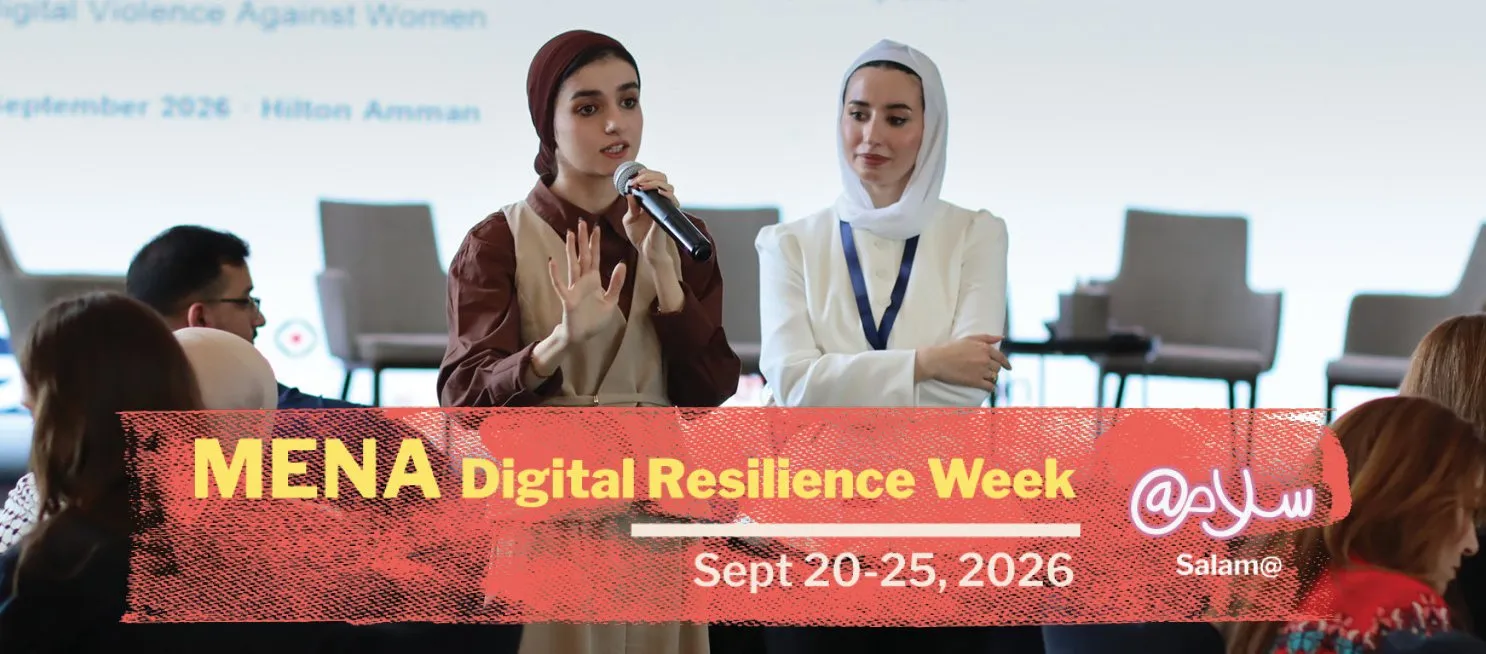

Across newsrooms, schools, legal practice, a library, and two major symposia, MENA Digital Resilience Week showed what happens when locally generated evidence on digital violence against women (DVAW) moves into the hands of people who can use it.
On a late-September Sunday morning at Amman’s Jordan Media Institute, a group of journalists sat with a draft guide on covering digital violence affecting teens. They were not being asked to endorse it. They were being asked to test it and help shape it.
Could a child be identified even if her name was removed? What should a reporter do with an abusive screenshot already circulating online? Would the guidance hold up under deadlines, newsroom hierarchies, and pressure to publish?

The Jordanian Network to Combat Digital Violence Against Female Journalists had convened the consultation alongside the SecDev Foundation. Behind the discussion was a powerful idea: journalism is not only a way of documenting digital violence after it happens. It can also be part of prevention. While protecting survivors, responsible reporting can shift how communities see digital violence, challenging old attitudes and opening space for survivors to seek help.
That consultation opened MENA Digital Resilience Week 2026, featuring six days of events. It brought together researchers, practitioners, journalists, educators, civil society organizations, and public institutions working to respond to DVAW. Many were already connected through a regional community that had grown over seven years, with support from the International Development Research Centre (IDRC) and SecDev’s Salam@ team.
Their research on DVAW across the Middle East and North Africa (MENA) had helped name harms that were once poorly documented, connect practitioners who’d been working in isolation, and build a shared body of locally rooted knowledge. But evidence was never meant to stop at publication. The hardest work is helping it travel — into professional standards, legal practice, classrooms, survivor support, institutions, stories, art, and the decisions people make every day.
Digital Resilience Week was built around that movement. It was less a sequence of events than a six-day test of what knowledge can become when local partners own and shape it.
A regional community takes stock
Genuine leadership must come from local partners. They are closest to reality and in direct contact with the people and communities concerned. Our continuing support must therefore center them.
The next morning, the sheer scale of the work came into focus. Some 100 researchers, lawyers, journalists, educators, government representatives, and civil society leaders gathered at the Hilton Amman for the Regional Symposium on Strengthening Resilience and Response to Digital Violence Against Women. Some had travelled to get there from Iraq, Algeria, and Palestine, and from as far away as Canada, Germany, France, and the U.K.

Co-sponsored by SecDev, IDRC, and the Information and Research Center – King Hussein Foundation (IRC–KHF), the symposium also featured senior representatives of Jordan’s Ministry of Digital Economy and Entrepreneurship. An exhibition showcased different ways of understanding and responding to DVAW — through research, practical guides, and youth artwork — while a digital clinic offered on-site support with device safety. A growing library of 40+ studies of DVAW reflected the depth of the work behind the gathering.
But the day was less about counting achievements than examining what had changed because of them. As SecDev’s Raed M. Sharif reminded everyone: seven years earlier, the very idea of digital violence against women had often met with blank stares. Now the room was full of people creating ways to prevent it, respond to it, and address institutional gaps that allow it to persist.
What changed on the ground?

Iraq’s Baghdad Women Association (BWA) had decades of experience supporting survivors of domestic violence, but increasingly found itself helping women and girls facing online threats. President Liza Hido explained how, working with SecDev and the Iraqi Network for Social Media (INSM), they developed an integrated response connecting its existing psychosocial and legal expertise with technical assistance. A woman seeking help could receive immediate emotional support, advice on preserving evidence, and assistance addressing harmful content online.
Liza also shared a difficult experience of her own. Attackers had compromised her email account and that of her financial officer, then tried to impersonate the association. INSM helped BWA secure its systems and protect decades of sensitive records. Sharing this was a powerful reminder: organizations supporting digital violence survivors need protection themselves.

Palestinian researcher Rita Ammar offered a stark example of why local context matters. Palestinian women share digital spaces but live under different legal jurisdictions. A woman in the West Bank blackmailed by someone in Jerusalem, she explained, may have no effective route to file a complaint. Even conducting research across these divisions means finding ways to reach women separated by restrictions on movement.
For Jordan’s Karak Castle Center, digital safety has become part of the organization’s identity. Lawyer and KCC CEO Esraa Mahadin described how this new area of work had grown as each activity revealed another need — among women in their homes, students, teachers, lawyers, and civil society organizations. Today, digital safety is one of KCC’s six core programmes, and the centre has become a source of expertise particularly in southern Jordan. Its latest research with 507 current and aspiring women leaders is helping shape approaches to protecting women’s participation in public life in the face of digital violence.

IRC–KHF‘s director, Dr. Ayman Halsa, highlighted a different challenge. Their research on DVAW and Jordanian law showed that gaps in coordination and legal interpretation could be just as consequential as gaps in legislation. To start tackling them more effectively, the centre helped establish a community of practice connecting legal experts, government bodies, researchers, and civil society.
These were different experiences, shaped by different circumstances, institutional strengths, and needs. That was the point of the symposium’s Localization Done Right discussion. It’s not enough to adapt a common model to different settings. Effective localization is about who identifies the problem, who decides when the original plan no longer fits, and who owns the relationships needed to carry the work forward.
The gathering also looked ahead. Discussions explored how journalism, education, emerging technologies, and stronger institutional relationships could help make prevention and response more durable. For this group, the question was no longer simply how to generate evidence of digital violence, but how to make that knowledge part of the institutions and professional practices women rely on.
Getting knowledge where it’s needed
We need to listen seriously to girls and boys and design research and practical work in which they are active contributors rather than passive recipients.
— Dr. Raed M. Sharif, SecDev Regional Manager (MENA)
On Tuesday, the conversation moved from the symposium hall to Maria Coptic School in Dhuleil, where 70 girls aged 13 and 14 had gathered to talk about online life. Rania Sarayreh, founder of the Jordanian journalists’ network, led a discussion built around questions the girls were already navigating.
Who can see my photos? When does a joke cross a boundary? What should I do if someone pressures me to share an image? Who can I turn to if something goes wrong?

Published in Arabic in December 2025, the English edition of Digital Shadows was released during MENA Digital Resilience Week.
Their starting point was Digital Shadows, the novel by Dr. Meriem Noumeur. Designed to bring insights from the DVAW research to MENA teens, the novel explores online identity, social pressure, privacy, and digital harm through fictional characters. Those characters gave the girls a way to discuss sensitive experiences, with no pressure to disclose their own. Each student also received Ready Online?, a digital-safety guide for teen girls.
The school session drove home a message that applies well beyond teenagers: knowledge is only useful when people believe they can act on it. Telling a young person to seek help means little if she expects blame, punishment, or disbelief when she does.
For the journalists, the school visit was part of a larger journey. Their network had grown from women reporters sharing their own experiences of digital violence into a community of more than 350 members working on research, advocacy, and prevention. Along the way, Digital Shadows had opened an unexpected path: conversations with young readers, including journalists’ own daughters, revealed gaps in how the media reported on digital violence affecting teens and helped shape the guide they had gathered to test on Sunday.

In parallel, another type of conversation was unfolding. At a legal workshop held in partnership with Global Project Partners, IRC–KHF launched its Practical Legal Guide on Digital Violence Against Women in Jordan, developed with SecDev. The guide aims to close the gap between knowing what the law says and knowing what to do when a survivor walks through the door. It helps legal professionals and service providers interpret legislation, preserve digital evidence, assess risks, and support women through legal processes. Held under the patronage of Jordan’s Minister of Justice, the workshop built on the Ministry’s support for bringing DVAW into legal training — extending that practical approach to practitioners already handling cases.

Changing channels again that evening, Digital Shadows reached another audience at the Abdul Hameed Shoman Public Library in Amman. There, Rania Sarayreh moderated a public conversation with Dr. Meriem Noumeur about pressures she explores in her book: social media, beauty standards, and the distance between a person’s online and offline personas. Audience questions brought families’ different experiences into the discussion. Meriem closed by reading an emotional page from her novel and offering participants copies to take home.
The legal guide and Digital Shadows offered very different ways of putting research to work. One gave professionals practical guidance for responding to digital violence; the other gave young people and families a shared story for talking about difficult experiences.
Building solutions across borders
The pain may be shared across countries, but each context is distinct. A sustainable movement must combine a common purpose with respect for those differences.
Monday’s symposium showed how local ownership and stronger institutional connections can improve responses to digital violence. Tuesday’s events showed how research could reach new audiences. On Wednesday, the conversation crossed borders: What could organizations across MENA learn from each other and accomplish together?

An online symposium convened over 110 researchers, practitioners, policymakers, and advocates from across the region and beyond. This event was co-hosted by SecDev, IDRC, the United Nations Population Fund (UNFPA), and the World Bank Group. Discussions explored prevention, response, and community engagement, and speakers offered fresh ideas for reaching people in different settings.
Algerian researcher Kawther Gasmi described working through trusted community organizations to reach women often missed by online campaigns, including those with limited literacy. Alexandra Kinias of Women of Egypt showed how the initiative uses storytelling to help women recognize and name experiences of digital harm, reaching an audience of two million social media followers. UNFPA’s Hela Oueslati introduced Netopoly, a Tunisian game that uses everyday situations to teach digital safety and help players identify sources of support.
Each approach grew out of a particular context. But sharing them opened new possibilities for others — not to copy the solutions wholesale, but to adapt the ideas behind them to their own communities.
Beyond awareness: Responses that work
The discussion also returned to a problem familiar from Monday’s symposium: recognizing digital violence is one thing; getting effective help is another.

Mounir Naili shared Salam@’s Arabic digital-safety sign language dictionary — developed with experts from nine countries for Deaf communities.
Women may know that reporting channels exist but hesitate to use them because they fear blame, stigma, or a breach of privacy. They may delete threatening messages without realizing they could be important evidence. Even with evidence in hand, it may establish that abuse happened without identifying the perpetrator. And platforms may hold information essential to a case. Effective support can require legal, technical, and psychosocial expertise that no single organization possesses.
INSM Executive Director Hayder Hamzoz described how the Iraqi organization’s digital helpdesk draws on relationships with technology platforms and other organizations across the region. When one case required help from a platform it couldn’t influence directly, INSM turned to a partner organization in Egypt that could. The case was addressed quickly.
The discussion also looked ahead to artificial intelligence and other evolving threats. Keeping pace will take more than awareness campaigns or occasional collaborations. It means strengthening laws and policies, making digital violence part of university education and professional training, and building better ways for institutions to work together.

Read more about IRC-KHF’s initiative to embed DVAW insights into professional training at Jordan universities.
IRC–KHF’s Sawsan Zaideh brought that challenge into focus, drawing on the centre’s work with universities to integrate DVAW into legal and journalism education. Her larger point: prevention and response need to become part of how institutions routinely work, with the capacity to keep learning and adapting as threats evolve.
All day, participants kept returning to a practical question: What more could they accomplish together regionally? They called for better access to shared research and tools, stronger referral relationships for cross-border cases, more direct engagement with technology companies, and more opportunities to solve problems together. Needs varied, but the basic ambition was shared: to build on the knowledge and capabilities already emerging across the region.
UNFPA, IDRC and SecDev concluded the day with a shared public call for more coordinated action across the region on DVAW. And the day’s strongest message: MENA is not a collection of problems waiting for solutions from elsewhere. The region is already producing methods, tools, relationships, and evidence that others can learn from.
Making the learning last
The first studies emerged from much more than academic curiosity. They emerged because women were asking questions that nobody could answer.
The final two days of MENA Digital Resilience Week were quieter. The microphones came off. The panels ended. The task shifted from presenting the work to writing it down.
A writing workshop set out to turn seven years of research and experience into a book and related resources. Not a catalogue of achievements, but an account of how the work evolved, what partners learned, and what others could build on.

The community fostered by Salam@ has so far generated 41 DVAW studies spanning 18 MENA countries. You can access them all.
There was plenty to draw from: a growing regional library of research studies, practical guides, educational materials, and other tools. Much of that knowledge emerged through a continuing exchange between research and practice. Digital-safety work exposed questions that research could explore. Findings shaped new tools and approaches. Local partners adapted them, revealing further needs and new questions.
The Salam@ journey has produced something invaluable: a community that has grown through the work. Researchers cite one another. Practitioners know who to call. Universities draw on material developed in their own region. Journalists, lawyers, educators, and service providers increasingly have tools designed for the contexts in which they actually work.
Projects end, people move on, and funding cycles close. But the relationships and shared expertise built through this work can outlast any one project.
The writing workshop made an appropriate final chapter for the week. After four days of seeing research and experience put to work in newsrooms, classrooms, institutions, and across borders, the task was to draw together what had been learned — and consider how to preserve it, share it, and make it useful for whatever comes next.
What the week made visible
What happens on the screen does not remain on the screen. It can affect a woman’s ability to work, learn, participate in public life, express her opinion, and feel safe.
MENA Digital Resilience Week did not produce one answer to digital violence against women. That was never the point. It made visible a way of working — and some of what seven years of experience have taught the community.

Evidence matters when it travels. Research has greater value when it changes a professional decision, a service, a classroom, an institutional relationship, or the way a young person understands what is happening to her.
Localization matters because local partners lead. They are not simply channels for delivering someone else’s intervention. They are researchers, decision-makers, practitioners, and relationship-builders who recognize needs, shape responses, and carry the work forward.
Connection matters because digital violence is not only digital. Its consequences reach into families, schools, workplaces, public life, justice systems, and mental health. A technical response without legal or psychosocial support may solve one part of a problem while leaving the rest untouched.
Knowledge translation is not an afterthought.A legal guide, a newsroom checklist, a novel, a digital clinic, or a regional conversation can each carry evidence to a different audience.
On the first morning of the week, journalists were asking whether a draft guide could withstand the pressures of a newsroom. By the end, the larger question was whether seven years of learning and relationships could endure beyond any one project.
The answer will depend on what institutions and partners do next. But there is now more to build on than there was seven years ago: local evidence, practical tools, experienced organizations, regional relationships, and a community increasingly able to draw these strengths together.
That may be the clearest meaning of digital resilience to emerge from the week: not the ability of one woman, one girl, or one organization to absorb harm alone, but the capacity of a wider ecosystem to learn, connect, respond, and keep getting stronger.
